Apple's Mixed Earnings Reflect Global Shifts: China Growth Masks Western Weakness Amid Geopolitical Risks
Apple's Q2 earnings show strong growth in China (+28% to $20.50 billion) but misses in the Americas and Europe, reflecting global consumer shifts. Beyond ZeroHedge's coverage, this analysis highlights geopolitical risks from U.S.-China tensions, Western economic slowdowns, and supply chain vulnerabilities as potential threats to tech valuations.
Apple's latest earnings report for its fiscal second quarter reveals a complex picture of global consumer dynamics and raises questions about the sustainability of tech valuations in a geopolitically tense environment. The company reported revenue of $111.18 billion, a 17% year-over-year increase, surpassing estimates of $109.66 billion. However, beneath the headline numbers lie stark regional disparities: while Greater China revenue surged 28% to $20.50 billion, beating estimates by over $1.5 billion, the Americas ($45.09 billion, missing estimates by $0.73 billion) and Europe ($28.06 billion, missing estimates by $1.02 billion) underperformed. This divergence, as reported in the original ZeroHedge coverage, points to deeper structural shifts in Apple's market dependence and potential vulnerabilities.
Beyond the numbers, the original coverage overlooks critical context about Apple's reliance on China. The 28% growth in Greater China, primarily driven by iPhone sales, aligns with Beijing's push to bolster domestic consumption amid its own economic recovery efforts post-COVID. Official data from China's National Bureau of Statistics shows a 4.7% year-over-year increase in retail sales of consumer goods for Q1 2024, with premium electronics forming a significant segment. Apple's performance in China may reflect not just brand strength but also strategic alignment with local policies, including potential subsidies or favorable supply chain dynamics under Xi Jinping's administration. However, the ZeroHedge piece's insinuation of 'cooked numbers' lacks evidence and distracts from a more plausible explanation: Apple's aggressive pricing strategies and localized marketing, as detailed in their Q2 earnings call transcript, likely fueled this growth.
What the original coverage also misses is the broader geopolitical risk tied to this China-heavy growth. Apple's increasing dependence on the Chinese market—now accounting for nearly 18.5% of total revenue—comes at a time of escalating U.S.-China tensions. The U.S. Department of Commerce's recent tightening of export controls on semiconductor technology (October 2023 Bureau of Industry and Security update) could disrupt Apple's supply chain, much of which is rooted in China via partners like Foxconn. If retaliatory measures from Beijing emerge, such as restrictions on rare earth exports critical for iPhone components, Apple's margins—already strained by a 34% year-over-year increase in R&D expenses to $11.42 billion—could face further pressure.
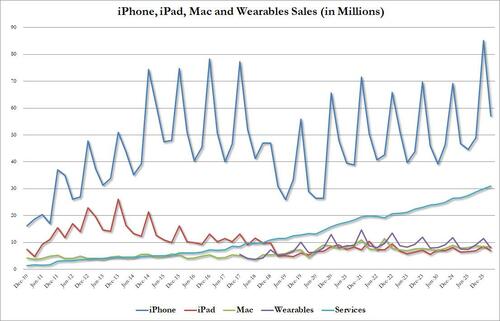
In the West, the revenue misses in the Americas and Europe signal weakening consumer confidence, likely tied to macroeconomic headwinds. Eurostat data for Q1 2024 indicates a stagnant EU GDP growth rate of 0.3% quarter-over-quarter, while U.S. consumer spending growth slowed to 2.5% annualized in the same period per the Bureau of Economic Analysis. These conditions suggest that premium-priced Apple products are losing ground to more affordable alternatives, a trend underexplored in the ZeroHedge report. Meanwhile, Apple's services revenue, up 16% to $30.98 billion, offers a buffer but may not fully offset hardware sales declines if Western markets continue to soften.
Synthesizing these insights with historical patterns, Apple's current trajectory mirrors tech giants' pre-2008 reliance on emerging markets for growth during Western slowdowns. Yet, unlike then, today's geopolitical landscape—marked by trade wars and supply chain nationalism—adds a layer of risk. A 2023 report by the International Monetary Fund highlights that global tech supply chains are 30% more fragmented than a decade ago due to policy-driven decoupling. Apple's China bet, while lucrative now, could become a liability if tensions boil over.
In conclusion, Apple's earnings reflect not just a company navigating market shifts but a bellwether for tech valuations broadly. Investors may be overlooking how regional disparities and geopolitical risks could erode the sector's premium multiples. The question remains whether Apple's pivot to services and emerging markets can sustain its growth—or if this mixed report is an early warning of deeper cracks.
MERIDIAN: Apple's heavy reliance on China for growth may backfire if U.S.-China tensions escalate, risking supply chain disruptions. Western market weakness could further pressure hardware sales, testing the resilience of tech valuations.
Sources (3)
- [1]Apple Fiscal Q2 2024 Earnings Report and Call Transcript(https://investor.apple.com/investor-relations/default.aspx)
- [2]U.S. Department of Commerce Bureau of Industry and Security Export Controls Update (October 2023)(https://www.bis.doc.gov/index.php/documents/regulations-docs/2582-federal-register-notice-announcing-new-export-controls-on-advanced-computing-and-semiconductor-manufacturing-items/file)
- [3]China National Bureau of Statistics Retail Sales Data Q1 2024(http://www.stats.gov.cn/english/PressRelease/202404/t20240416_1948264.html)