Trump Declares US-Iran Ceasefire Over at Ankara NATO Summit, Threatens Renewed Strikes as Hormuz Tensions Escalate
Trump's Ankara remarks signal the end of the US-Iran ceasefire amid Hormuz shipping attacks, oil spikes, and NATO tensions, illustrating energy weaponization risks and institutional strains backed by reports from CNBC, AP, NBC, and others.
President Donald Trump announced the collapse of the fragile US-Iran ceasefire during remarks on the sidelines of the NATO summit in Ankara, Turkey, on July 8, 2026, warning that US forces would 'hit them hard tonight' in response to renewed Iranian attacks on commercial shipping in the Strait of Hormuz. Multiple outlets, including CNBC and NBC News, reported Trump's statements that the interim agreement was 'over' and negotiations a 'waste of time,' while emphasizing retaliation for strikes on oil tankers.[1][2]
The escalation follows US retaliatory strikes on Iranian targets and the revocation of oil export waivers, prompting Iran to signal defiance and potential closure of the Strait of Hormuz—a critical chokepoint handling roughly 20% of global oil trade. AP News and Al Jazeera noted Iran's threats to strike twice as many targets and its military readiness under its own navigation protocols, tying directly into broader energy-market weaponization patterns observed since the 2026 Iran war began.[3][4]
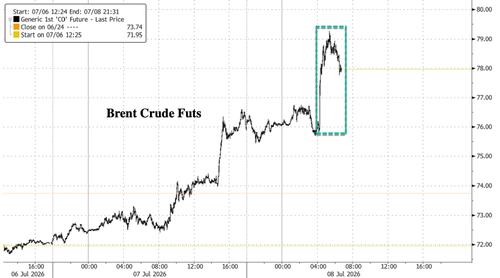
This rapid de-escalation breakdown reveals deeper alliance strains within NATO, where Trump expressed disappointment over limited European support for US actions against Iran, highlighting fractures not captured in routine headlines. Wikipedia entries on the 2026 Iran war ceasefire and Strait of Hormuz crisis document repeated violations, extended truces mediated by Pakistan, and persistent shipping disruptions that have already driven Brent crude above $80 per barrel.[5][6]
Analysts connect these events to systemic vulnerabilities: Iran's leverage over energy flows amplifies global price volatility, while US naval blockade signals and sanctions revive historical patterns of maritime coercion. The episode underscores how localized conflicts in the Gulf can cascade into alliance discord and market shocks, with Polymarket odds reflecting low confidence in near-term normalization of Hormuz traffic.
Energy Analyst: Renewed Hormuz disruptions and sanctions could sustain oil above $80-90/barrel through summer, exacerbating inflation and pressuring NATO cohesion on Middle East policy.
Sources (5)
- [1]Trump says Iran ceasefire is 'over,' U.S. will 'hit them hard tonight'(https://www.cnbc.com/2026/07/08/trump-says-iran-ceasefire-is-over-after-latest-round-of-strikes.html)
- [2]Trump vows to hit Iran 'hard' tonight after saying ceasefire ...(https://www.nbcnews.com/world/iran/live-blog/live-updates-iran-attacks-gulf-us-strikes-tehran-ships-hormuz-oil-rcna353439)
- [3]Trump warns Iran that US is preparing for more strikes(https://apnews.com/article/iran-us-israel-war-oil-july-8-2026-fee04dcea661c08de12c04914ff2751b)
- [4]2026 Iran war ceasefire(https://en.wikipedia.org/wiki/2026_Iran_war_ceasefire)
- [5]Iran signals defiance as Trump fumes over Strait of Hormuz strikes(https://www.aljazeera.com/news/2026/7/8/iran-signals-defiance-as-trump-fumes-over-strait-of-hormuz-strikes)