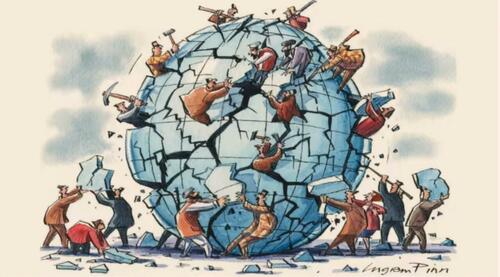
The Silent Fracture of Global Order: Geopolitical Shifts and Economic Risks
The global order is fracturing quietly, marked by the expiration of New START and a Russia-China alignment. Beyond geopolitical shifts, this poses economic risks through de-dollarization, supply chain disruptions, and market volatility. Historical patterns and overlooked regional tensions amplify the stakes.
The global order, once underpinned by treaties and strategic balances, is dissolving in a way that is both subtle and profound. As Milan Adams notes in the original ZeroHedge piece, the expiration of the New START treaty on February 5, 2026, passed without fanfare, yet it marks a historic shift: for the first time in over five decades, no binding agreement limits the strategic nuclear arsenals of the United States and Russia. This is not merely a diplomatic failure but a structural erosion of predictability that once constrained great-power rivalry. Beyond this, the tightening alignment between Russia and China signals a deeper realignment, one driven not by ideology but by shared opposition to U.S. dominance. This article delves into the overlooked economic implications of this fracture, the historical patterns it mirrors, and the blind spots in current coverage.
First, the economic dimension of this geopolitical shift is underexplored in the original piece. The Russia-China partnership, while not a formal alliance, has accelerated de-dollarization efforts and alternative trade mechanisms, such as the use of national currencies for bilateral trade. According to a 2023 report by the Bank of Russia, over 90% of Russia-China trade is now conducted in rubles and yuan, up from less than 20% a decade ago. This trend, coupled with initiatives like the BRICS payment system, poses a long-term risk to the U.S. dollar’s status as the world’s reserve currency. Such a shift could destabilize global financial markets, increase volatility in commodity pricing (especially energy), and disrupt supply chains already strained by sanctions and geopolitical tensions. Mainstream coverage often frames these moves as symbolic, but they reflect a pragmatic effort to insulate key economies from U.S.-led financial coercion.
Second, the historical context reveals a pattern of miscalculation. The original article rightly notes the failure of the U.S. strategic triangle approach—balancing Russia and China against each other—but misses how this echoes past errors. During the late Cold War, U.S. policymakers assumed cultural and historical divides would prevent a deep Russia-China alignment. Yet, as seen in the 1950s Sino-Soviet Treaty of Friendship, temporary alignments can form under shared external pressure, only to fracture later due to internal contradictions. Today’s partnership, however, is more durable due to economic interdependence: China’s need for Russian energy and raw materials complements Russia’s need for Chinese markets amid Western sanctions. This mutual reliance, absent in the Cold War era, suggests a longer-lasting bloc, one that could reshape global trade routes and security architectures.
Third, the original coverage underplays the cascading effects of arms control collapse beyond nuclear arsenals. The end of New START not only removes warhead limits but also eliminates verification mechanisms, increasing the risk of miscalculation in crises. A 2022 report by the U.S. Department of State highlighted that without on-site inspections, intelligence gaps widen, potentially leading to overreactions based on incomplete data. This uncertainty extends to conventional forces and emerging domains like cyber and space, where no equivalent guardrails exist. The quiet nature of this dissolution—lacking the drama of a Berlin Wall moment—masks its gravity, leaving markets and policymakers unprepared for sudden escalations.
Finally, connecting these threads, the fracturing global order poses systemic risks to international trade and financial stability. The Russia-China axis, combined with the absence of arms control, creates a dual threat: strategic unpredictability and economic decoupling. For instance, heightened tensions in the Arctic—where Russia and China are expanding cooperation—could disrupt critical shipping lanes, impacting global energy and commodity flows. The original piece mentions Moscow’s testing of U.S. resolve in Venezuela but misses broader implications for resource-rich regions. A 2023 NATO report warns of increasing Russian naval activity in the Western Hemisphere, signaling a potential for proxy conflicts over resources, further straining supply chains.
In synthesis, while the ZeroHedge article captures the quiet nature of this global fracture, it overlooks the economic ripple effects and historical parallels that amplify its significance. The interplay of strategic realignment and arms control collapse is not just a geopolitical story but a market risk story—one that could redefine global stability in ways yet unseen.
MERIDIAN: The erosion of arms control and rise of a Russia-China bloc may trigger unexpected shocks to global markets within the next 18 months, as trade routes and financial systems face mounting pressure from geopolitical uncertainty.
Sources (3)
- [1]Bank of Russia Annual Report 2023(https://www.cbr.ru/eng/statistics/annual_report/)
- [2]U.S. Department of State Report on Arms Control Compliance 2022(https://www.state.gov/arms-control-verification-and-compliance-report/)
- [3]NATO Strategic Foresight Analysis 2023(https://www.nato.int/nato_static_fl2014/assets/pdf/2023/10/pdf/231023-strategic-foresight-analysis.pdf)