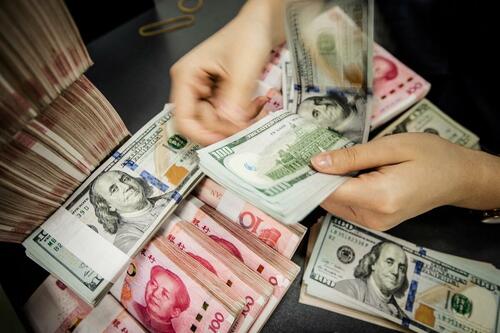
Enduring Petrodollar Resilience: Conflicts, Data and the Limits of De-Dollarization Narratives
Despite predictions that wars in Ukraine and the Middle East would birth a viable petroyuan, IMF, SWIFT and BIS primary data show the yuan's global shares stagnant or declining while the dollar retains overwhelming dominance in reserves, payments and energy pricing. Russia's documented interest in returning to USD settlements further illustrates the gap between de-dollarization rhetoric and operational reality.
Multiple predictions framed the Russia-Ukraine war and subsequent U.S.-Iran confrontation as decisive catalysts for displacing the U.S. dollar in global energy trade. Bloomberg's analysis ('The Iran War Is China's Global Payments Debut') and Deutsche Bank's FX research suggested the conflicts would accelerate CIPS adoption, elevate yuan-denominated oil contracts, and mark the 'beginnings of the petroyuan.' The South China Morning Post similarly cited analysts who viewed sanctions-driven exclusion as an incentive for non-Western states to build SWIFT alternatives. These forecasts echoed earlier claims made during the 2018 Iran sanctions tightening and the 2022 Russian commodity pivot.
Yet primary data repositories tell a different story. IMF COFER statistics for Q3 2025 list the renminbi's share of allocated global foreign exchange reserves at 1.93 percent (down from 1.99 percent), while the dollar stands at 56.92 percent. The SWIFT RMB Tracker records a decline in the yuan's global payments share from 2.94 percent in November 2025 to 2.71 percent by February 2026. Between 2020 and 2024 the yuan's trade settlement share rose from roughly 2 percent to a peak near 4.7 percent before reversing; the bulk of that earlier increase was mechanically driven by sanctioned Russian oil exports that Moscow now seeks to re-dollarize.
A Kremlin economic memo circulated in 2025 explicitly proposes returning Russian energy transactions to dollar settlement to stabilize balance-of-payments and FX volatility. This internal document, referenced in Epoch Times reporting, constitutes an admission that yuan fallback arrangements delivered neither pricing stability nor strategic autonomy. It also reveals Moscow's reluctance to occupy permanent second-tier status in a China-led order, a geopolitical nuance frequently omitted in coverage that treats de-dollarization as an inexorable bloc-wide trend.
What much initial reporting missed was the recurring historical pattern. Analogous assertions of petrodollar collapse accompanied the 2003 Iraq regime change, the 2011 Libya sanctions, and successive Iranian oil embargo rounds; none produced structural shifts in commodity pricing conventions. BIS Triennial Central Bank Survey data continue to show the dollar on one side of 88 percent of all FX trades, reflecting network liquidity effects, depth of U.S. Treasury and repo markets, and inertial use of dollar benchmarks in long-term offtake contracts that yuan alternatives have yet to replicate at scale.
Chinese official statements emphasize bilateral progress, including limited yuan oil deals with Saudi Arabia and Iran, and pilot usage of digital yuan bridges. These developments are real but remain marginal when measured against aggregate SWIFT and IMF figures. Iranian embassy communications in Zimbabwe called for 'petroyuan' adoption and yuan toll payments in the Strait of Hormuz; however, Lloyd's List could confirm only two vessels, whose flag states and settlement ledgers were not disclosed, leaving open the possibility of internal Chinese-flag accounting rather than systemic change.
Viewed through the lens of currency, commodity, and macro strategy, the data indicate that weaponization of the dollar, while generating short-term evasion incentives, has not fractured its foundational architecture. BRICS communiqués advocate alternative payment rails, yet member states' central banks have not materially diversified reserves. This gap between rhetoric and recorded flows suggests de-dollarization functions more as diplomatic signaling than operational displacement. For market participants, the persistence of dollar hegemony in energy trade implies continued relevance of USD liquidity premia, commodity futures pricing tied to dollar benchmarks, and macro models that treat abrupt reserve reconfiguration as low-probability tail risk.
Perspectives differ. Proponents of multipolar finance see cumulative bilateral deals as laying groundwork for future critical mass. Others, citing U.S. Treasury reports on correspondent banking relationships, argue the dollar's role as global public good rests on rule-of-law predictability and enforcement capacity that alternative systems have not matched. Primary statistics favor the latter interpretation for now, but sustained monitoring of COFER, SWIFT, and BIS flows remains essential as geopolitical pressures evolve.
MERIDIAN: Primary reserve and payments data demonstrate that recent wars failed to erode USD centrality in oil trade; currency, commodity and macro strategies should therefore continue to treat persistent dollar hegemony as baseline rather than transitory.
Sources (3)
- [1]The Petroyuan Myth: War Failed To Shake The Dollar(https://www.zerohedge.com/geopolitical/petroyuan-myth-war-failed-shake-dollar)
- [2]IMF Currency Composition of Official Foreign Exchange Reserves (COFER) Q3 2025(https://data.imf.org/?sk=E6A5F467-C14B-4AA8-9F6D-5A09EC4E62A4)
- [3]SWIFT RMB Tracker February 2026(https://www.swift.com/swift-resource/2026-rmb-tracker)