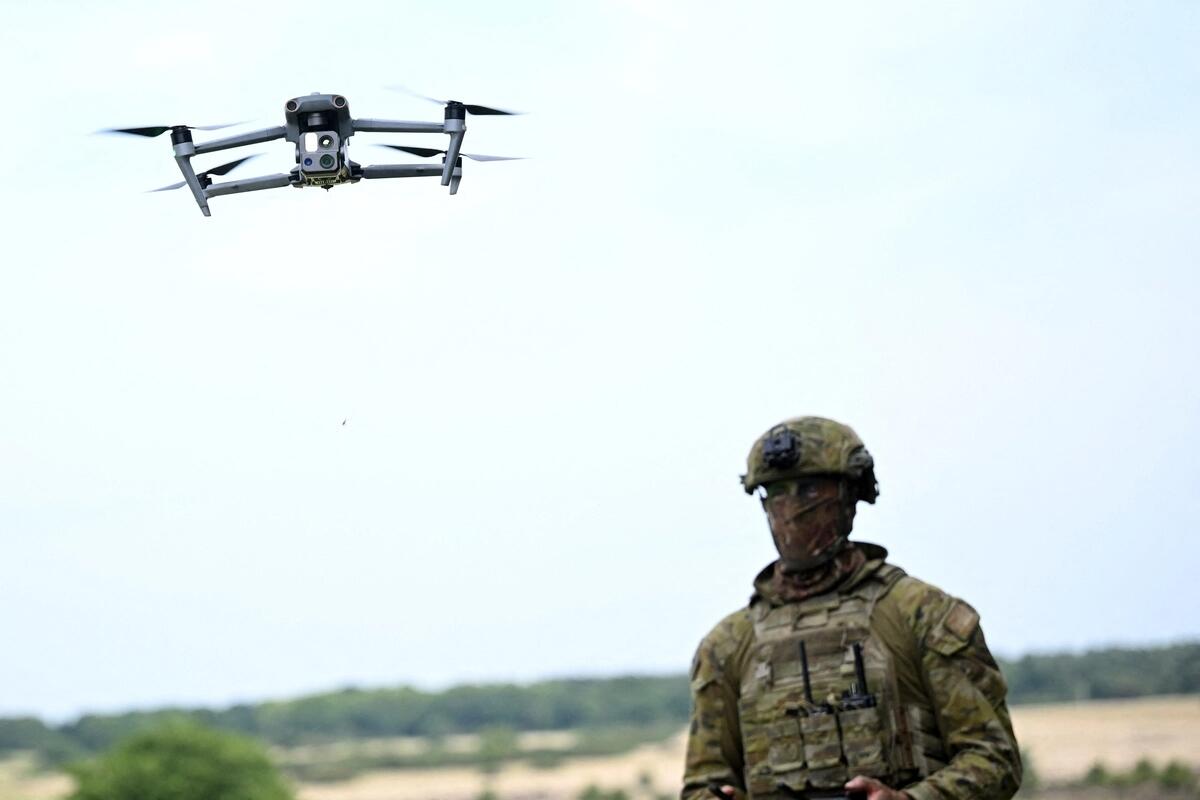
Pentagon Accelerates Directed-Energy Counter-Drone Defenses Amid Rising Swarm Threats
Corroborated reports confirm the DoW's JIATF-401 pilot selecting four directed-energy systems from AeroVironment, Epirus, Kord, and Boeing for counter-drone testing at U.S. bases, driven by swarm threats and NDAA requirements. This aligns with Hegseth's push for rapid capability fielding amid global drone proliferation.
In a significant step toward operationalizing directed-energy weapons for homeland defense, the U.S. Department of War has selected four high-energy laser and high-powered microwave systems for a year-long pilot program under the Joint Interagency Task Force 401 (JIATF-401). The systems—AeroVironment’s Palletized High-Energy Laser, Epirus’ Leonidas high-powered microwave, Kord’s Firefly laser, and Boeing’s Compact Laser Weapon System—will be tested at five installations: Fort Huachuca (AZ), Fort Bliss (TX), Naval Base Kitsap (WA), Grand Forks AFB (ND), and Whiteman AFB (MO).[1][2]
This effort, mandated by the FY2026 National Defense Authorization Act, follows warnings from military leaders about vulnerabilities to low-cost drone swarms. Brig. Gen. Matt Ross, JIATF-401 director, emphasized layered defenses, noting that lasers and microwaves offer cost-effective options against proliferating unmanned systems seen in conflicts like Ukraine-Russia and tensions in the Strait of Hormuz.[3] A December 'shoot-off' at Dugway Proving Ground may add more systems, with successful performers potentially purchased immediately.
Secretary of War Pete Hegseth has framed drone warfare as a generational shift, pushing for both 'quality and quantity' in capabilities while directing the removal of bureaucratic barriers to accelerate counter-drone approvals from months to days or weeks.[4] The pilot builds on prior FAA coordination, including safety assessments at White Sands, enabling domestic testing without airspace disruptions.
Broader context reveals a Department of War restructuring under Hegseth, including consolidation of unmanned systems oversight and the planned Autonomous Warfare Command, signaling a strategic pivot toward attritable, mass-deployable autonomous systems to counter adversaries' low-cost drone proliferation. This could reshape cost-exchange ratios in future engagements, enhance base protection, and influence international norms around directed-energy use in contested airspace.[5]
Technological implications include maturing AI-enabled targeting for swarm defeat (microwaves excel here) versus precision strikes (lasers), with real-world data informing sustainment, integration with NORAD, and export controls. While promising for asymmetric defense, challenges remain in power requirements, weather resilience, and rules of engagement for homeland scenarios.
[Analyst]: Expansion of these capabilities could shift military cost asymmetries in drone-heavy conflicts, prompting allies and adversaries to accelerate similar programs while raising questions about escalation thresholds and arms control in directed-energy domains.
Sources (5)
- [1]Pentagon picks 4 vendors for counter-drone directed energy pilot program(https://breakingdefense.com/2026/10/pentagon-picks-4-vendors-for-counter-drone-directed-energy-pilot-program/)
- [2]JIATF 401 selects four systems for directed-energy pilot(https://insidedefense.com/insider/jiatf-401-selects-four-systems-directed-energy-pilot)
- [3]Systems Selected for JIATF 401 Directed-Energy Counter-Drone Pilot Program(https://www.war.gov/News/Releases/Release/Article/4619430/systems-selected-for-jiatf-401-directed-energy-counter-drone-pilot-program/)
- [4]Pentagon names 4 directed-energy weapons for counter-drone program at US bases(https://www.militarytimes.com/industry/techwatch/2026/10/06/pentagon-names-4-directed-energy-weapons-for-counter-drone-program-at-us-bases/)
- [5]Hegseth Unveils New Autonomous Warfare Command(https://www.airandspaceforces.com/hegseth-drones-autonomous-warfare-command-state-of-the-force/)