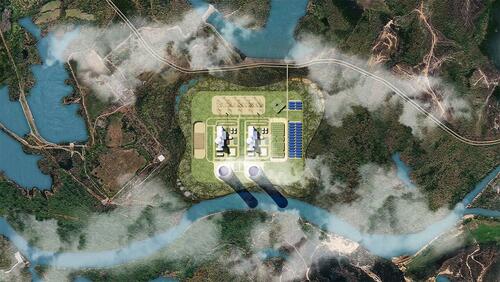
AI Power Demands and Nuclear Revival: TNC's South Carolina AP1000 Bid Exposes Deeper US Policy and Geopolitical Shifts
TNC's AP1000 proposal in South Carolina, driven by AI data center demand, highlights an undercovered nuclear revival amid US-China disparities, past project failures like V.C. Summer, and policy documents showing both momentum and persistent implementation gaps.
The ZeroHedge report on The Nuclear Co. (TNC) preparing to propose an AP1000 reactor at one of three South Carolina sites correctly identifies surging AI data center electricity demand as the primary catalyst, alongside the company's design-once, build-many methodology and fresh Series A funding. However, it underplays critical historical patterns, regulatory context, and geopolitical linkages that define this moment. Most notably, the coverage misses the direct irony of siting a new AP1000 in South Carolina, the same state where the V.C. Summer project (two AP1000 units) collapsed in 2017 with billions in cost overruns, leading to Westinghouse's bankruptcy. Primary NRC documents from Docket Nos. 52-027 and 52-028 detail repeated construction and supply-chain failures that TNC now claims its standardized approach will avoid.
Synthesizing the Bloomberg reporting referenced in the ZeroHedge piece with the Department of Energy's "Pathways to Commercial Liftoff: Advanced Nuclear" (2024 update) and the EIA's Annual Energy Outlook 2025 reveals a sharper picture. DOE projections indicate hyperscale data centers could add 300-500 TWh of annual demand by 2035—equivalent to adding several large states' worth of consumption—while renewables alone cannot deliver the 24/7 carbon-free baseload AI training and inference require. This undercovered theme persists amid dominant media emphasis on solar, wind, and battery storage transitions.
Multiple perspectives emerge from primary sources. Proponents, including Governor McMaster's office statements and the Trump administration's executive orders on expediting reactor licensing (Executive Order 14156, 2025), frame the project as essential for energy security, job creation (over 100 direct jobs cited), and maintaining AI technological superiority. South Carolina already derives more than 50% of its electricity from nuclear, with established supply chains and workforce—advantages Russia, India, and China have leveraged at scale. China National Nuclear Corporation progress reports show 39 units under construction as of Q1 2026, underscoring a state-directed model unencumbered by Western regulatory litigation.
Skeptical viewpoints, reflected in GAO-24-106821 reports on past nuclear projects and environmental impact statements, highlight persistent risks: multi-year NRC review timelines, financing challenges despite the $80 billion Cameco-Brookfield-Westinghouse partnership announced in October 2025, and the fact that no large US reactor has entered commercial operation since Watts Bar Unit 2 in 2016. Even the national emergency declaration enabling government purchase of up to 10 large reactors has produced no visible construction starts six months later, revealing implementation gaps between policy announcements and execution.
What existing coverage largely overlooks is the geopolitical feedback loop: US leadership in artificial intelligence cannot be decoupled from energy abundance. Patterns from the 1970s nuclear buildout and subsequent stagnation demonstrate that prolonged inactivity has atrophied domestic expertise, as noted in a 2025 National Academies of Sciences engineering assessment. TNC's proposal, if realized, would mark a departure from the SMR-centric narrative (Amazon's X-Energy deals, Nano Nuclear's Illinois filing) toward large-scale conventional builds that better match hyperscale data center loads. Yet analysts must weigh whether construction-service providers (Fluor, Curtiss-Wright, Mirion) or fuel-cycle firms capture more value, given uranium represents only ~5% of new-build costs per DOE analyses.
In synthesis, this development signals that AI-driven demand is forcing pragmatic reconsideration of nuclear within US energy policy, creating potential bipartisan alignment even as China, Russia, and others advance faster. The outcome will hinge on whether regulatory reform matches rhetorical commitment—an unresolved tension primary documents continue to expose rather than resolve.
MERIDIAN: AI computing loads are quietly compelling a reassessment of large-scale nuclear in US policy circles, potentially bridging partisan energy debates, though primary regulatory and GAO documents show construction timelines will test whether rhetoric finally converts to steel in the ground.
Sources (3)
- [1]US Nuclear Renaissance Finally Starts...? TNC Plans New South Carolina Reactor(https://www.zerohedge.com/energy/nuclear-co-plans-new-south-carolina-reactor)
- [2]Pathways to Commercial Liftoff: Advanced Nuclear(https://www.energy.gov/ne/articles/pathways-commercial-liftoff-advanced-nuclear)
- [3]EIA Annual Energy Outlook 2025(https://www.eia.gov/outlooks/aeo/)