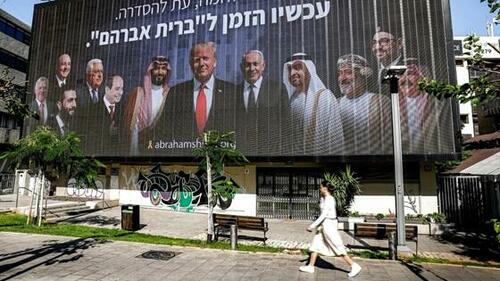
Trump's 'Mandatory' Abraham Accords: Forcing a New Middle East Order That May Include Iran
Trump demands mandatory expansion of Abraham Accords to Saudi Arabia, Qatar and others as prerequisite for Iran deal, with surprising openness to Iranian inclusion in a grand regional bloc. Corroborated by AP, Reuters, WaPo and others; signals potential forced realignment with major economic and security implications but faces skepticism over feasibility and genuine commitment.
President Donald Trump's May 25, 2026 Truth Social post has sent shockwaves through diplomatic circles by declaring that participation in the Abraham Accords should be 'mandatory' for key Arab and Muslim-majority states as a precondition for any comprehensive settlement with Iran. According to multiple reports, Trump referenced weekend calls with leaders from Saudi Arabia, Qatar, Pakistan, Türkiye, Egypt, Jordan, Bahrain, and the UAE, insisting that Saudi Arabia and Qatar lead by signing immediately, with others to follow or risk exclusion from the broader deal.[1][2]
This represents a significant evolution from the original Abraham Accords, brokered during Trump's first term, which normalized ties between Israel and the UAE, Bahrain, Morocco, Sudan, and others, delivering documented economic booms in trade, technology, and investment even amid regional conflicts. Trump highlighted these successes, framing expansion as essential to creating 'a United, Powerful, and Economically Strong' Middle East.[3]
The most heterodox element—and one rarely discussed in mainstream coverage—is the overture to Iran itself. Trump suggested that if Tehran reaches an agreement with the US, several regional leaders expressed they would be 'honored' to see the Islamic Republic join the Accords. This pivot comes against a backdrop of recent intense US-Iran tensions, including threats of escalated conflict and blockade measures in the Strait of Hormuz. It signals a potential grand bargain: demanding Iran curtail its nuclear program and proxy networks in exchange for economic integration and normalization with former adversaries.[4]
Deeper analysis reveals this 'mandatory' framing as a strategic shift from voluntary diplomacy to coercive architecture. By tying Iran negotiations to universal normalization with Israel, Trump is attempting to bypass the Palestinian issue as a veto point and construct a US-centric economic and security bloc. This could redraw alliances in ways that marginalize hardline rejectionists, counter Chinese and Russian influence, and create a integrated market rivaling other global blocs. Senator Lindsey Graham called the proposal 'brilliant,' arguing it could yield 'the most significant change in the Middle East in thousands of years.'[5][5]
However, credible reporting highlights substantial hurdles. Saudi Arabia has cooled on full normalization since the Gaza war, with Crown Prince Mohammed bin Salman prioritizing other priorities. Forcing participation risks domestic backlash in countries like Türkiye, Jordan, and Pakistan, where public opinion remains hostile to Israel ties. Critics warn that a coerced rather than organic expansion could prove fragile, lacking genuine buy-in and potentially fueling instability or new proxy conflicts. Doubts also surround Iran's willingness—or ability under its current regime—to join a framework centered on Israeli normalization.[6][7]
This move aligns with Trump's deal-maker persona but carries long-term consequences for regional sovereignty. It reframes the Abraham Accords not merely as bilateral peace deals but as a mandatory membership card into a US-orchestrated 'World Coalition.' If successful, it could end decades of Iranian isolation and Sunni-Shia fault lines; if it fails, it may accelerate fragmentation. As negotiations continue, the coming weeks will test whether mandatory diplomacy can deliver the historic realignment Trump envisions or expose the limits of imposed regional order.
Liminal: Framing normalization as 'mandatory' could forge an unprecedented US-led economic-security architecture integrating Iran and former foes, but risks breeding resentment and fragile alliances that fracture under domestic pressures.
Sources (6)
- [1]Trump says it should be 'mandatory' for more countries to join the Abraham Accords as part of Iran deal(https://www.nbcnews.com/politics/trump-administration/trump-says-mandatory-countries-join-abraham-accords-part-iran-deal-rcna346816)
- [2]Trump says Iran deal should include additional countries joining Abraham Accords(https://www.pbs.org/newshour/world/trump-says-iran-deal-should-include-additional-countries-joining-abraham-accords)
- [3]Graham hails Trump's Abraham Accords push after Iran deal criticism: ‘Brilliant’(https://thehill.com/homenews/senate/5894032-lindsey-graham-donald-trump-abraham-accords-us-iran-deal/)
- [4]Trump seeks to widen Abraham Accords as new Iran deal faces sharp criticism(https://www.washingtonpost.com/world/2026/05/25/trump-seeks-widen-abraham-accords-new-iran-deal-faces-sharp-criticism/)
- [5]Trump links Abraham Accords to any Iran deal(https://www.reuters.com/world/middle-east/trump-links-abraham-accords-iran-deal-2026-05-25/)
- [6]Trump pushes Arab, Muslim leaders on Israel ties(https://www.axios.com/2026/05/24/trump-iran-war-israel-muslim-countries-abraham-accords)