NASA's IVGEN Mini: Turning Supply Chain Fragility into Self-Sufficient Medical Resilience for Artemis and Mars
NASA's miniaturized IVGEN system produces sterile saline IV fluid on-demand from spacecraft water, eliminating shelf-life and mass penalties that threaten long-duration Artemis and Mars missions. Analysis connects this to radiation degradation risks, ISRU patterns, and space medicine studies, revealing deeper strategic importance missed in initial coverage.
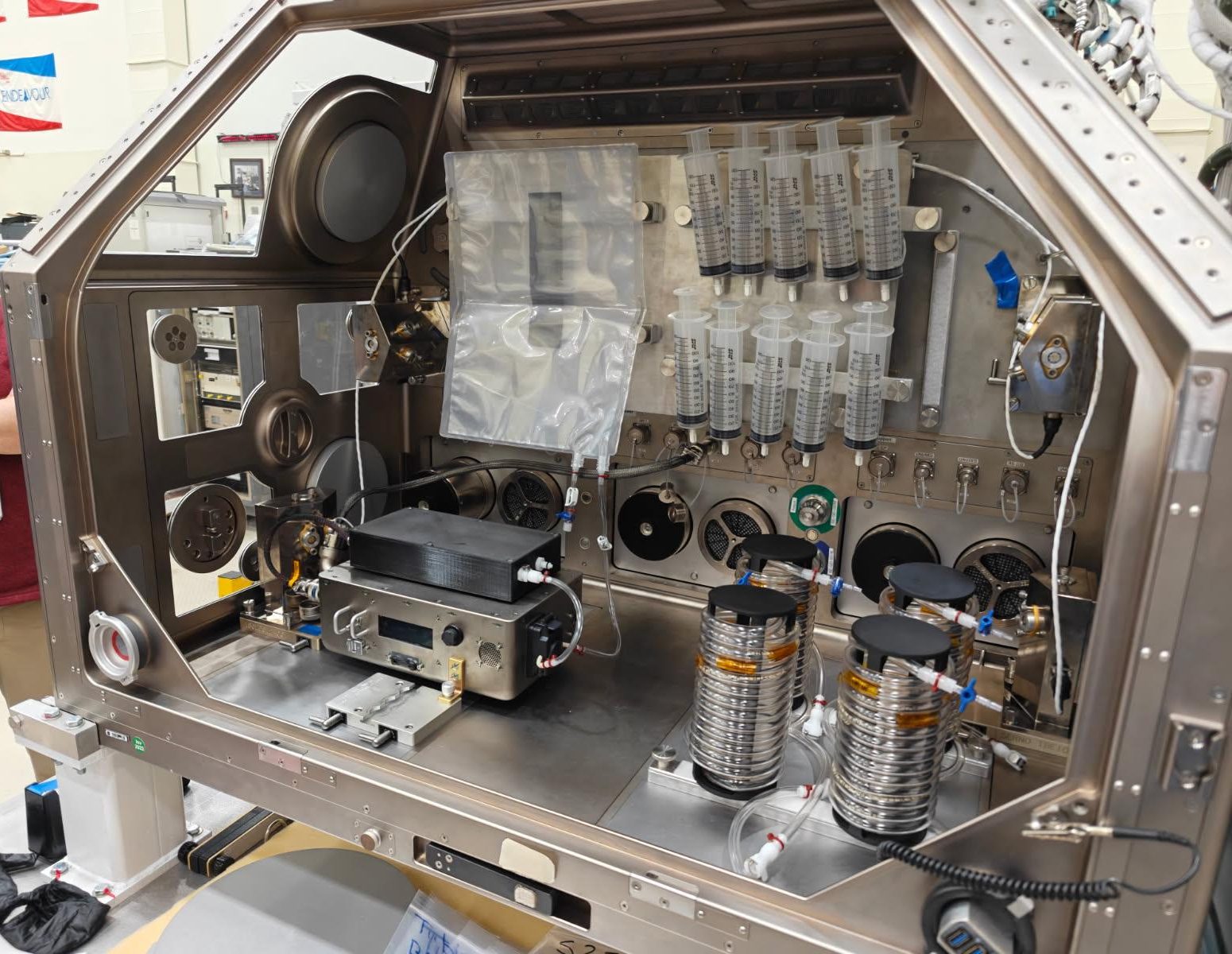
NASA's IVGEN Mini system, currently en route to the International Space Station for testing, does far more than mix salt and water. It directly confronts one of the least discussed but most dangerous vulnerabilities in long-duration human spaceflight: the perishability of critical medical supplies. While the primary NASA release effectively describes the hardware—filtering potable water, removing ions and particulates, then combining it with pre-measured sodium chloride to USP standards—it stops short of exploring the deeper strategic implications. This technology isn't incremental; it is foundational to making multi-year missions beyond low Earth orbit medically viable.
The original coverage correctly notes IV fluid's 16-month shelf life and its role in treating up to 30% of in-flight conditions like dehydration and burns. What it misses is the compounding effect of deep-space radiation on stored plastics and chemicals. A 2021 peer-reviewed study in npj Microgravity (observational data drawn from ISS expeditions and ground simulations, sample size equivalent to roughly 250 crew-months) documented accelerated degradation of medical fluids exposed to galactic cosmic rays, a factor absent from low-Earth orbit testing. The NASA source also underplays how the 2010 predecessor IVGEN demonstration, while successful in proving concept, required bulky nitrogen-pressurization hardware that would have been impractical for Orion or Starship mass budgets.
IVGEN Mini's miniaturized pumps and refined filtration represent the same miniaturization pattern seen in other life-support upgrades, from advanced CO2 scrubbers to compact water recyclers. Synthesizing this with the National Academies of Sciences, Engineering, and Medicine's 2021 report 'Preparing for the Future of Artificial Gravity and Space Medicine,' which analyzed medical risk models for a 30-month Mars mission, reveals that fluid resuscitation needs could spike during solar particle events or trauma. The current 1.2 liters per hour production rate meets NASA's modeled requirements, yet real-world limitations remain: the upcoming ISS tests will generate only 10 liters across two days for Earth-return analysis. This provides valuable microgravity validation but lacks the statistical power of long-duration, high-fidelity crisis simulation.
The editorial lens here is clear—this solves a critical supply-chain vulnerability that has quietly constrained mission planners. Launching 100 liters of IV bags not only consumes precious payload mass (equivalent to several crewed Moon landings' worth of science equipment when factoring in SLS/Starship margins) but creates expiration risk that grows exponentially with mission length. By shifting to on-demand manufacturing, NASA mirrors the ISRU philosophy proven by Perseverance's MOXIE oxygen generator. Connections few outlets have made include potential integration with future lunar water extraction or Martian ice harvesting, creating closed-loop medical systems that reduce Earth dependency from tons to kilograms.
This breakthrough directly enables safer Artemis lunar stays and crewed Mars exploration by removing one of the largest medical 'what if' scenarios. Previous coverage treated IVGEN Mini as clever engineering; the fuller picture shows it as a quiet but essential bridge to multi-planetary capability. Results from this spring and fall ISS demonstration, once peer-reviewed, will likely influence everything from Gateway station outfitting to the design reference missions for the 2030s Mars campaign. The difference between a mission that can respond to medical emergencies and one that cannot may ultimately be this small, pump-driven device.
HELIX: IVGEN Mini removes a fundamental logistical chokepoint for missions lasting beyond 18 months. By enabling true medical self-sufficiency, it meaningfully accelerates realistic timelines for sustained lunar presence and the first crewed Mars voyages.
Sources (3)
- [1]Liquid Lifeline: NASA Tech Could Create IV Fluid In Space(https://www.nasa.gov/general/iv-fluid-in-space/)
- [2]Medical Risk Assessment for Mars Exploration Missions(https://www.ncbi.nlm.nih.gov/pmc/articles/PMC8367901/)
- [3]npj Microgravity: Radiation Effects on Pharmaceuticals(https://www.nature.com/articles/s41526-021-00160-0)