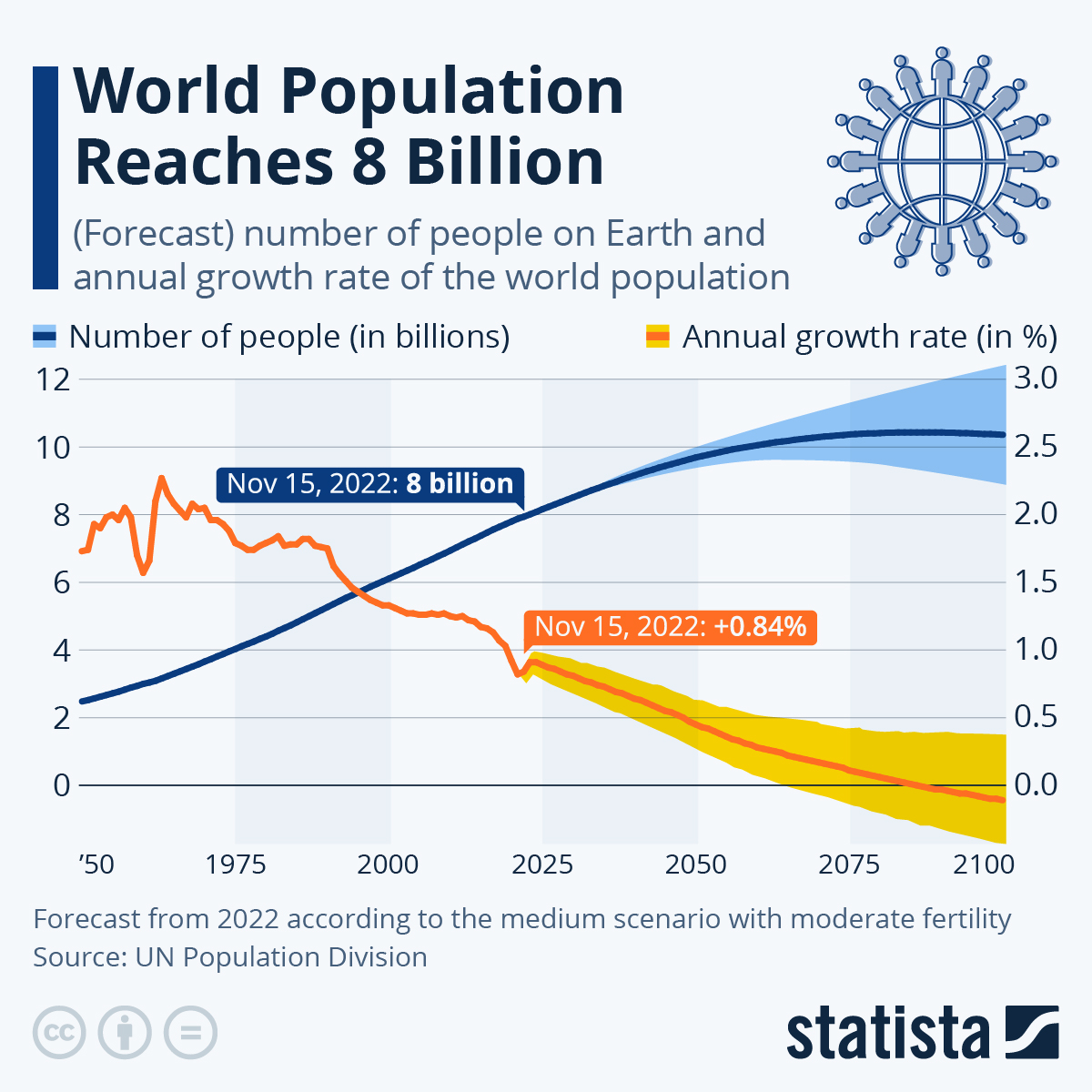
Global Population to Peak at 10.3 Billion in 2084 Before Gradual Decline, UN Projects, With Ripple Effects on Labor, Pensions, and Geopolitics
UN 2024 projections validate slowing global growth with a 2084 peak at 10.3B followed by decline; Lancet scenarios suggest steeper drops. Under-covered effects include pension strains, labor shortages, migration pressures, and geopolitical realignments from aging societies.
The United Nations' World Population Prospects 2024 revision confirms that global population growth is decelerating, aligning closely with earlier analyses from Statista and the UN Population Division. Under the medium variant, the world population—estimated at 8.2 billion in 2024—will continue rising for roughly six decades before peaking at approximately 10.3 billion in the mid-2080s (around 2084), then declining slowly to 10.2 billion by 2100. This represents an earlier and slightly lower peak than prior projections, driven by faster-than-expected fertility declines, particularly in China and parts of sub-Saharan Africa. An 80% probability exists that the peak will occur within this century. A lower-fertility scenario could see reversal as early as the early 2060s, capping below 10 billion and falling to around 9 billion by century's end. Complementing this, the 2020 Lancet/IHME study forecasted even sharper declines, projecting 8.8 billion by 2100 under reference scenarios or as low as 6.3 billion with rapid development, underscoring uncertainty around sustained low fertility. These trends mark a shift from the explosive growth of the 20th century—fueled by healthcare gains and high birth rates in Asia and Africa—to an era of demographic contraction in many regions. Eastern and Southeastern Europe lead current declines due to low fertility and emigration, while India remains the top contributor to absolute growth and African nations like Somalia and Chad retain the highest fertility rates. Beyond raw numbers, the reversal carries underappreciated systemic consequences. Aging populations in high-income and emerging economies will strain pension systems, healthcare, and labor markets, as the worker-to-retiree ratio worsens. Analyses such as "The Great Demographic Reversal" by Goodhart and Pradhan highlight potential returns to inflation, higher interest rates, and fiscal pressures from rising old-age dependency, with OECD countries facing elderly-related spending increases of nearly 7% of GDP by 2050. Labor shortages may accelerate automation, raise participation rates among older workers, or intensify migration competition—yet inflows sufficient to stabilize ratios could reach hundreds of millions in developed nations. Geopolitically, power may shift toward youthful regions like sub-Saharan Africa, whose share of global population grows even as absolute peaks arrive later. IMF and related studies note these dynamics could reshape trade, savings rates, and intergenerational equity, demanding policy adaptations beyond incremental tweaks. While fertility rebounds or massive migration remain possible mitigators, current trajectories suggest a civilizational pivot from population-driven growth to one constrained by aging and contraction.
Policy Analyst: Countries ignoring demographic contraction will face acute pension insolvency and workforce gaps by 2040-2050, forcing either radical immigration scaling, retirement age hikes, or productivity revolutions via AI and automation to sustain living standards.
Sources (5)
- [1]World Population Prospects 2024: Summary of Results(https://population.un.org/wpp/assets/Files/WPP2024_Summary-of-Results.pdf)
- [2]Fertility, mortality, migration, and population scenarios for 195 countries and territories from 2017 to 2100 (The Lancet, 2020)(https://www.thelancet.com/article/S0140-6736(20)30677-2/fulltext)
- [3]New UN population projections: Where are we headed? (Population Connection)(https://populationconnection.org/blog/new-un-population-projections-where-are-we-headed/)
- [4]Peak global population and other key findings from the 2024 UN World Population Prospects (Our World in Data)(https://ourworldindata.org/un-population-2024-revision)
- [5]The Great Demographic Reversal (SUERF Policy Note)(https://www.suerf.org/wp-content/uploads/2023/12/f_fa99ccdbea597263a88f27075bd6eb49_17385_suerf.pdf)