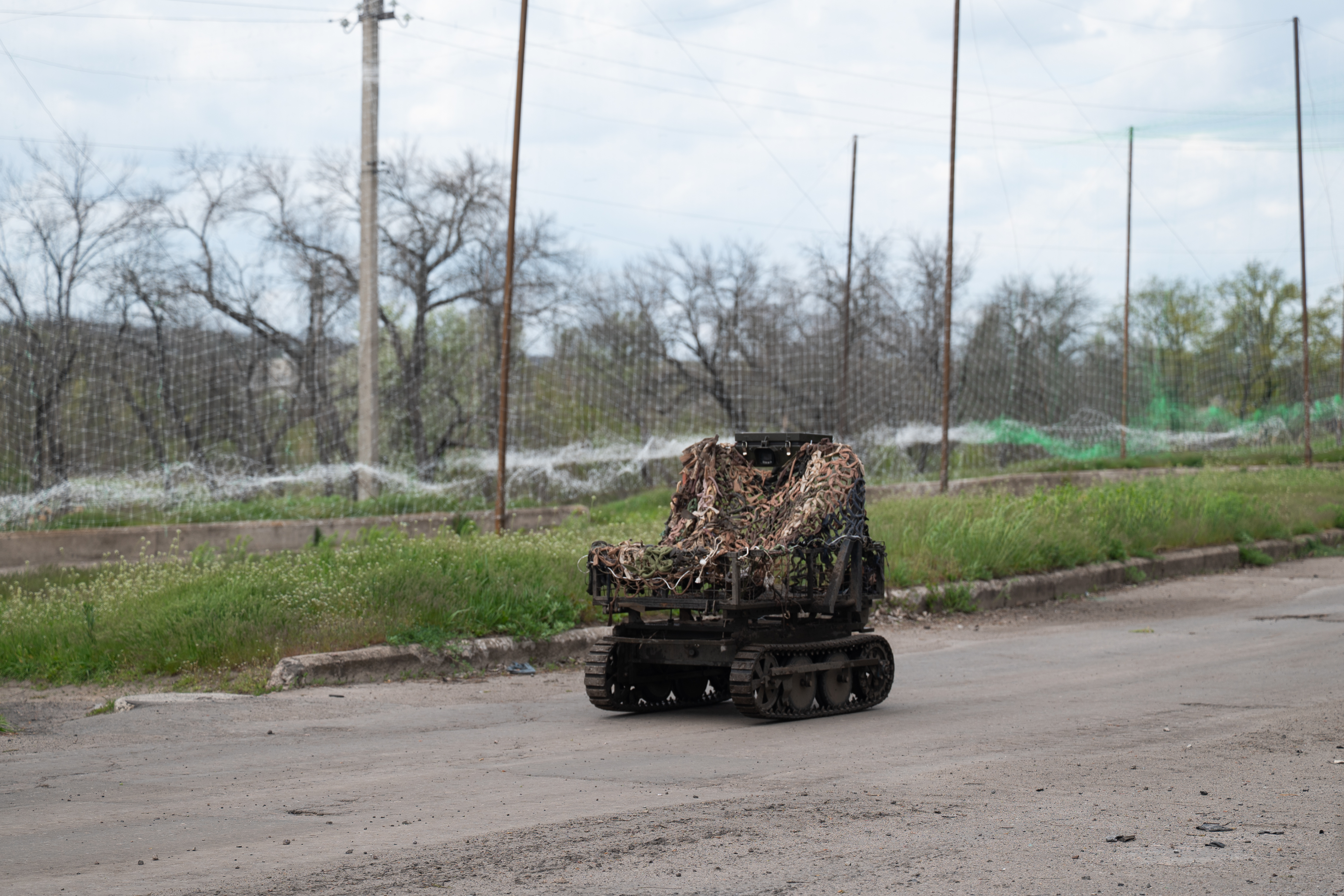
Ukraine's Ground Robot Surge: A New Frontier in Autonomous Warfare and Humanitarian Aid
Ukraine’s rapid deployment of 50,000 ground robots in 2026 highlights a dual-use doctrine blending military and humanitarian missions, like the Lyman civilian rescue. This reflects a global shift to autonomous warfare, raises ethical and cybersecurity risks, and positions Ukraine as a testbed for future conflict tech.
Ukraine's rapid scaling of ground robot production, as reported by Defense News, marks a pivotal shift in modern warfare, with over 50,000 unmanned ground vehicles (UGVs) slated for deployment in 2026 alone. Beyond the headline numbers, this development signals a deeper transformation: the integration of autonomous systems into both military and humanitarian operations, reflecting a broader trend in global defense toward AI-driven warfare. The Cerberus unit’s rescue of a 77-year-old civilian in Lyman on April 25, alongside routine ammunition hauls and casualty evacuations, underscores a dual-use doctrine that Ukraine’s Unmanned Systems Forces (SBS) explicitly frame as strategic. This isn’t mere improvisation—it’s a deliberate pivot to minimize human risk, as articulated by Defense Minister Mykhailo Fedorov’s goal of fully robotic frontline logistics.
What the original coverage misses is the broader geopolitical and technological context. Ukraine’s push mirrors a global race to dominate autonomous warfare, evident in the U.S. Department of Defense’s Replicator initiative, which aims to field thousands of autonomous systems by 2025, and China’s heavy investment in AI-driven military tech, as detailed in a 2025 RAND Corporation report. Ukraine, however, operates under unique constraints—facing an attritional war with Russia, it cannot afford the manpower losses that traditional tactics demand. The reported 30% reduction in personnel casualties via UGVs isn’t just a statistic; it’s a survival mechanism for a nation outgunned in conventional terms. This also challenges the narrative of robotics as purely offensive tools, revealing their potential as life-saving assets in contested zones where human rescuers cannot tread due to drone saturation—a detail the original story underplays.
Moreover, Ukraine’s dual-use doctrine connects to historical patterns of wartime innovation under duress. During World War II, necessity birthed technologies like radar; today, Ukraine’s UGVs are a 21st-century equivalent, born from existential need rather than luxury R&D budgets. Yet, risks loom unaddressed in the source material. The proliferation of autonomous systems raises ethical questions about accountability in civilian interactions—how are decisions to prioritize rescue over combat logistics made? And what of cybersecurity? A 2024 CSIS report on autonomous weapons warned of vulnerabilities to hacking, a threat magnified in Ukraine’s digitized battlefield where Russian electronic warfare units are notoriously active.
Synthesizing additional sources, such as a Reuters report on Ukraine’s drone warfare scaling and the aforementioned RAND analysis, it’s clear that Ukraine’s UGV surge isn’t just a local story—it’s a microcosm of a power shift toward smaller, tech-savvy nations leveraging asymmetry against larger adversaries. This also hints at a future where humanitarian missions could be increasingly roboticized, a trend worth watching as NATO and other allies observe Ukraine’s real-world testing ground. While the original story paints a hopeful picture of ‘Grandma, get on!’, it glosses over the systemic challenges of scaling such tech under wartime conditions—supply chain bottlenecks, operator training, and the psychological toll on soldiers who must trust machines with lives. Ukraine’s experiment, if successful, could redefine not just its war, but the ethical and operational boundaries of autonomous systems worldwide.
SENTINEL: Ukraine’s UGV surge could inspire smaller nations to adopt autonomous tech as a force multiplier, but expect cybersecurity vulnerabilities to become a critical battleground as adversaries target these systems.
Sources (3)
- [1]Ukraine Ramps Up Ground Robot Production(https://www.defensenews.com/unmanned/2026/05/08/ukraine-ramps-up-ground-robot-production-to-spare-soldiers-haul-ammo-and-rescue-grandma/)
- [2]Ukraine's Drone Warfare Scaling(https://www.reuters.com/world/europe/ukraine-boosts-drone-production-war-enters-new-phase-2025-03-15/)
- [3]RAND Corporation: China's AI Military Investments(https://www.rand.org/pubs/research_reports/RRA1234-1.html)