Stockman's Debt Trap Warning Gains Urgency Amid Persistent High Yields and Bipartisan Spending Patterns
Stockman's analysis of bipartisan fiscal profligacy post-1980 is substantiated by OMB/FRED spending data and current Treasury yields above 5%, pointing to mounting risks from the $40T+ debt load and interest burdens.
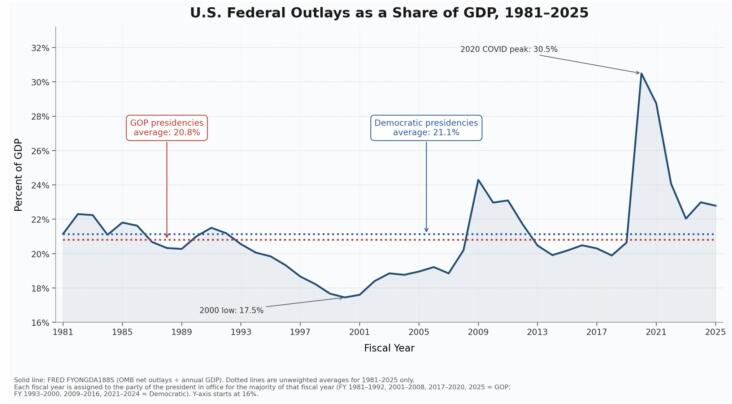
Former Reagan budget director David Stockman argues in a recent analysis that both major U.S. political parties have contributed to a structural fiscal imbalance since 1980, with federal spending averaging around 21% of GDP under administrations of either party—far higher than the pre-1980 GOP average of about 17.5%. This dynamic, he contends, renders tax cuts insufficient to address deficits when outlays remain elevated, setting the stage for a debt-interest spiral exacerbated by 10-year Treasury yields recently climbing above 5%.[1]
Official data largely aligns with the spending trends described. Federal net outlays as a percent of GDP have hovered in the low-to-mid 20s in recent years, reaching 22.7% in FY2025 per FRED data derived from OMB figures, up from lower historical baselines under earlier Republican administrations.[2] Analyses from the Cato Institute and YCharts historical series show nondefense and total federal spending shares rising notably post-2000 across Bush, Obama, Trump, and Biden terms, with limited restraint even during periods of GOP control.[3][4] Pre-1980 data from OMB historical tables further supports a clearer partisan divergence in earlier decades.[5]
Current market conditions amplify the concern. The 10-year Treasury yield has traded above 5% multiple times in October 2026, with peaks near 5.31% and recent closes around 4.9-5.1%, reflecting investor sensitivity to fiscal trajectories.[6] Broader debt metrics underscore the stakes: U.S. public debt has surpassed $40 trillion, with annual interest costs exceeding $1 trillion and consuming over one-fifth of federal revenue, per contemporaneous reporting.[7] Independent fiscal commentary echoes the unsustainability of the trajectory without major spending adjustments.[8]
Stockman's core thesis—that the 'true tax rate' of government is its spending share of GDP, per Milton Friedman—highlights how post-1980 policy convergence on elevated outlays has decoupled revenue policy from expenditure restraint, leaving borrowing as the default. Government statistical agencies provide the raw data trail confirming these averages, while debt service pressures in a higher-rate environment add empirical weight to the warning.
Policy Analyst: Elevated yields and debt service costs will intensify pressure for spending restraint in the current administration, potentially accelerating debates over entitlement reform and discretionary cuts beyond recent proposals.
Sources (6)
- [1]A Century of Federal Spending, 1925-2025(https://www.cato.org/blog/century-federal-spending-1925-2025)
- [2]Federal Net Outlays as Percent of Gross Domestic Product(https://fred.stlouisfed.org/series/FYONGDA188S)
- [3]10 Year Treasury Rate(https://ycharts.com/indicators/10_year_treasury_rate)
- [4]National debt hits $40 trillion as interest costs top $1 trillion(https://www.foxnews.com/opinion/americas-debt-crisis-threatens-our-childrens-future-we-people-need-fix-it)
- [5]America's Fiscal Doomsday Machine Must Be Stopped(https://brownstone.org/articles/americas-fiscal-doomsday-machine-must-be-stopped/)
- [6]US Government Spending (Yearly)(https://ycharts.com/indicators/us_government_spending_percent)