Private Credit: Shadow Banking Risks Echo 2008 Subprime Crisis but Face Less Scrutiny
Private credit's growth in shadow banking presents systemic risks echoing 2008 through opacity and interconnections, though experts debate the scale of spillovers; it warrants more attention than it currently receives compared to visible economic indicators.
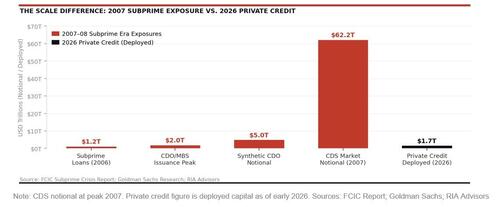
The rapid expansion of the private credit market, now exceeding $1.7 trillion in assets, has drawn comparisons to the opaque financial instruments that fueled the 2008 Global Financial Crisis. Unlike traditional bank lending, private credit operates largely in the shadows as part of non-bank 'shadow banking,' with limited transparency, internal 'mark-to-model' valuations, and growing interconnections to private equity, insurance companies, and even regulated banks through credit lines and equity stakes. Goldman Sachs CEO David Solomon recently highlighted risks in his shareholder letter, citing weakening underwriting standards, exposure to AI-disrupted software companies, and the persistence of the credit cycle—warnings echoed by former Goldman leader Lloyd Blankfein about the system inching toward potential catastrophe.
This echoes key elements of the subprime crisis: layered complexity, misaligned incentives, and underestimation of contagion risks. In 2008, synthetic CDOs amplified exposure far beyond actual subprime loans through derivatives. Today, private credit's opacity and liquidity mismatches—funds with redemption gates facing rising defaults in sectors like automotive and tech—could amplify stress. While many private credit loans are held rather than securitized like pre-2008 mortgages, the Boston Fed has questioned whether this growth poses risks to overall financial stability through banks' exposures. Senators Elizabeth Warren and Jack Reed have urged regulators to stress-test the private credit market due to its potential spillovers to the banking sector.
Yet views differ. JPMorgan and Barron's analyses argue problems are contained, concentrated in specific sectors, with banks better capitalized post-2008 reforms and no direct exposure akin to mortgage-backed securities. Moody's Analytics notes private credit's growing systemic importance due to linkages and lack of transparency, recommending expanded regulatory oversight, improved data reporting, and monitoring of leverage and liquidity. PBS reporting features economists like Jeffrey Gundlach predicting private credit as the next major crisis trigger, while Moody's economist Mark Zandi sees it as consequential but not yet systemically threatening. Duke researchers suggest private lenders behave more like investors than banks, shifting rather than amplifying risks.
What others miss is how private credit receives far less public and media scrutiny than inflation metrics or headline banking issues, despite its role financing middle-market firms and PE deals amid higher interest rates. With retail inflows slowing and defaults rising (Fitch noting increases to around 5-9% in early 2026), a broader economic slowdown could expose valuation gaps and force fire sales or bank interventions—revealing dangerous systemic vulnerabilities in unregulated shadow finance that parallel 2008's underappreciated leverage and opacity.
LIMINAL: Private credit's hidden connections to banks and insurers could turn sector-specific defaults into a broader credit crunch, quietly amplifying economic pain while regulators focus elsewhere.
Sources (5)
- [1]Why private credit is creating major concerns among economists(https://www.pbs.org/newshour/show/why-private-credit-is-creating-major-concerns-among-economists)
- [2]Private Credit Problems Aren’t a Systemic Threat to the Financial System(https://www.barrons.com/articles/private-credit-market-economy-d2387514)
- [3]Goldman Sachs Just Sounded the Alarm on Private Credit(https://www.fool.com/investing/2026/03/21/goldman-sachs-just-sounded-the-alarm-on-private-cr/)
- [4]Could the Growth of Private Credit Pose a Risk to Financial System Stability?(https://www.bostonfed.org/publications/current-policy-perspectives/2025/could-the-growth-of-private-credit-pose-a-risk-to-financial-system-stability.aspx)
- [5]Warren, Reed Call on Banking Regulators to Take Immediate Action to Address Cracks in Credit Markets(https://www.banking.senate.gov/newsroom/minority/warren-reed-call-on-banking-regulators-to-take-immediate-action-to-address-cracks-in-credit-markets)