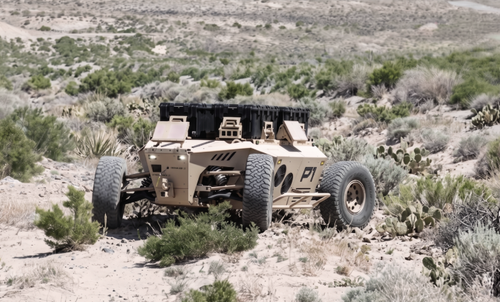
Hypercraft's Razorback: Autonomous Laser-Capable UGVs Signal Escalating AI Arms Race in Modern Warfare
Hypercraft's Razorback UGV, capable of powering laser weapons and operating fully autonomously, exemplifies rapid advances in military robotics amid the Russia-Ukraine war, but raises under-discussed ethical issues around AI accountability, lethal autonomy, and conflict escalation.
The unveiling of the Razorback by Utah-based Hypercraft represents a concrete step in the militarization of autonomous ground systems capable of powering lethal directed-energy weapons. As detailed in Defence Blog, this diesel-hybrid-electric UGV features a 300 hp powertrain, 280-mile range, 60 mph top speed, 2,400-pound payload capacity, and the ability to export 38 kW of continuous power—sufficient to operate laser weapons, charge drone swarms, sustain electronic warfare suites, and power forward command posts without reliance on vulnerable generator convoys or human operators. Similar technical specifications are corroborated by Defense Advancement, which positions the Razorback as a software-defined tactical microgrid for high-consequence environments, including counter-UAS missions integrated with systems like Fortem Technology's radar and interceptors.
This development does not occur in isolation. The ongoing Russia-Ukraine conflict has already validated a new paradigm of machine-centric attrition warfare, where cheap UGVs and drones dominate 'no man's land,' progressively displacing human infantry from direct fire zones. Hypercraft's platform accelerates this trend by addressing the critical energy bottleneck for sustained autonomous operations, enabling longer-duration missions with lethal effectors such as high-energy lasers.
What remains largely missing from mainstream defense discussions is the deeper ethical and strategic implications. Specialized coverage of the Razorback has been confined to niche outlets, yet it directly intersects with broader concerns over lethal autonomous weapons systems (LAWS). Analyses from the Lieber Institute at West Point highlight the 'accountability gap' inherent in AI-driven targeting: when machines independently select and engage targets, traditional international humanitarian law principles of distinction, proportionality, and precaution become difficult to enforce due to algorithmic opacity and the absence of meaningful human control. Likewise, the Centre for International Governance Innovation (CIGI) underscores how delegating lethal decisions to autonomous platforms raises fundamental questions of human dignity, moral responsibility, and escalation risks, as robotic systems lower the political barriers to prolonged conflict by minimizing friendly casualties.
Connections others miss include the convergence of hybrid-electric mobility, directed-energy weapons, and software-defined autonomy. By functioning as a mobile power node rather than merely a logistics carrier, the Razorback enables distributed, resilient kill webs that could proliferate to peer adversaries, fueling an arms race where sustained laser engagements in contested airspace or ground domains become routine. As militaries observe successes in Eurasian conflicts, the trajectory toward humanoid robotics entering the battlespace appears inevitable—pushing ever more decision-making into algorithms while ethical and legal frameworks struggle to keep pace.
This fringe perspective reveals autonomous military technology not merely as an efficiency gain but as a paradigm shift that could normalize machine warfare, erode deterrence thresholds, and demand urgent international norms before deployment outpaces governance.
Liminal Autonomy Analyst: Widespread fielding of high-power autonomous UGVs like Razorback will reduce barriers to sustained robotic combat, enabling longer attritional wars with fewer human costs and accelerating an unregulated AI arms race that outpaces ethical oversight and international law.
Sources (4)
- [1]Utah-based firm develops Razorback autonomous combat vehicle(https://defence-blog.com/utah-based-firm-develops-razorback-autonomous-combat-vehicle/)
- [2]Hypercraft Debuts Razorback Hybrid UGV for Software-Defined Tactical Operations(https://www.defenseadvancement.com/news/hypercraft-debuts-razorback-hybrid-ugv-for-software-defined-tactical-operations/)
- [3]Legal Accountability for AI-Driven Autonomous Weapons(https://lieber.westpoint.edu/legal-accountability-ai-driven-autonomous-weapons/)
- [4]The Ethics of Automated Warfare and Artificial Intelligence(https://www.cigionline.org/the-ethics-of-automated-warfare-and-artificial-intelligence/)