US AI Data Center Buildout Exposes Strategic Vulnerability Through Dependence on Chinese Electrical Components
America's AI expansion is constrained by shortages of transformers, switchgear and batteries, forcing reliance on Chinese imports and exposing supply chain vulnerabilities that undermine claims of tech supremacy.
While the United States positions itself as the global leader in artificial intelligence, the physical infrastructure enabling the AI boom reveals a critical Achilles' heel: heavy reliance on Chinese-manufactured electrical equipment essential for powering massive data centers. According to a detailed Bloomberg investigation, the US is importing thousands of high-power transformers from China, with imports surging to more than 8,000 units through October 2025 compared to fewer than 1,500 in all of 2022. For specific types of transformers and switchgear, China's share remains around 30 percent despite overall efforts to diversify. This dependence is not abstract—lead times for high-power transformers have extended to up to five years, far exceeding the less than 18 months required for AI projects.
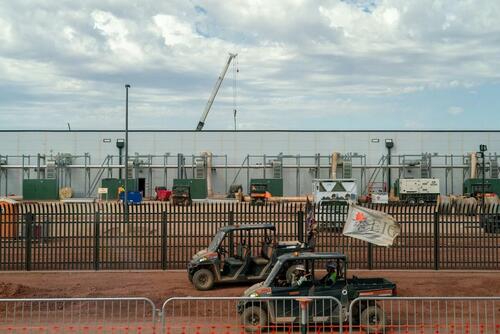
A prime example is the 1.2-gigawatt data center under construction in Abilene, Texas, for OpenAI, which rivals the output of a nuclear reactor. Domestic manufacturing has failed to scale sufficiently, with Wood Mackenzie projecting 30 percent supply deficits for power transformers and 10 percent for distribution transformers in 2025, driven by surging electricity demand from data centers, renewables integration, and aging infrastructure. Reuters reported that approximately 80 percent of power transformers supplied in the US that year would be imported. Battery supply chains show similar patterns, with Chinese share exceeding 40 percent.
This bottleneck challenges narratives of unchallenged American technological supremacy. While policy focuses on semiconductor export controls and chip leadership, the unglamorous but vital components—transformers, switchgear, and batteries—represent a point where the US must turn to its strategic competitor to sustain the AI arms race. Experts like Wood Mackenzie's Benjamin Boucher note that lacking domestic capacity forces reliance on the export market, while academics warn that abrupt decoupling could further delay projects and harm US competitiveness. Efforts by companies like GE Vernova and Siemens to expand US production are underway but insufficient to meet immediate demand.
The situation underscores deeper systemic issues: decades of underinvestment in grid infrastructure colliding with explosive AI-driven power needs. Without accelerated reshoring or alternative sourcing, trillions in planned hyperscaler investments risk delays or cancellations, with nearly half of 2026 data center projects already threatened. This dependency creates potential leverage for China in any escalation of tech tensions, inverting the typical narrative of US dominance.
Liminal: This reliance on Chinese electrical hardware for US AI infrastructure creates a hidden chokepoint that could let geopolitical rivals disrupt American tech leadership at the physical layer, proving that dominance in algorithms requires independence in the electric grid components that power them.
Sources (4)
- [1]America’s AI Build-Out Hinges on Chinese Electrical Parts(https://www.bloomberg.com/news/features/2026-04-01/us-ai-data-center-expansion-relies-on-chinese-electrical-equipment-imports)
- [2]US faces transformer supply shortfall as power demand surges, WoodMac says(https://www.reuters.com/business/energy/us-faces-transformer-supply-shortfall-power-demand-surges-woodmac-says-2025-08-14/)
- [3]Power transformers and distribution transformers will face supply deficits of 30 and 10 in 2025(https://www.woodmac.com/press-releases/power-transformers-and-distribution-transformers-will-face-supply-deficits-of-30-and-10-in-2025/)
- [4]America's Data Center Boom Must Not Depend on Chinese Batteries(https://nationalinterest.org/blog/techland/americas-data-center-boom-must-not-depend-on-chinese-batteries)