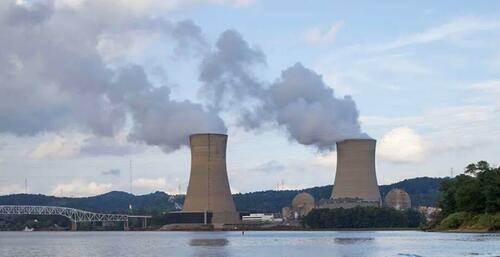
AI Power Surge Meets Regulatory Thaw: Unpacking America's Nuclear Momentum Beyond NRC Reforms
NRC Part 53 rules and DOME completion mark regulatory progress toward advanced reactors, but AI data center demand is the true underreported catalyst driving a multi-year uranium-SMR-utility investment cycle. Original coverage missed market signals and geopolitical supply shifts; mainstream climate narratives have underplayed nuclear's reliability role.
The ZeroHedge piece centered on the Nuclear Regulatory Commission's issuance of final Part 53 rules seven years after President Trump signed the Nuclear Energy Innovation and Modernization Act (NEIMA) correctly flags a procedural milestone. However, it underplays the primary catalyst now accelerating nuclear development: explosive electricity demand from AI data centers. Where the original coverage emphasizes regulatory timelines and skepticism from advocates like Steven Curtis and NANO Nuclear CEO James Walker regarding remaining site-specific reviews, it misses how private-sector market signals are outpacing federal bureaucracy.
Primary documents tell a broader story. The NRC's Part 53 framework (Federal Register, Vol. 89, No. 146, July 29, 2024) explicitly adopts technology-inclusive, risk-informed, performance-based licensing to accommodate non-light-water reactors using molten salt, gas, or liquid metal coolants. This responds directly to NEIMA's Section 103 directives. Yet the real momentum traces to converging demand forecasts. The U.S. Energy Information Administration's Annual Energy Outlook 2024 and a complementary IEA Electricity 2024 report project U.S. data centers could consume between 6-12% of national generation by 2030, equivalent to adding multiple large states' worth of load. Hyperscalers including Microsoft, Amazon, and Google have executed power purchase agreements and restart deals, most notably Microsoft's July 2024 agreement with Constellation Energy to revive Three Mile Island Unit 1.
This connection reveals patterns the original coverage and much mainstream climate reporting overlooked. Previous nuclear policy pushes (the 2005 Energy Policy Act incentives, post-Fukushima stall, Obama-era loan guarantees) lacked a structural demand driver immune to political cycles. AI training clusters require always-on, high-capacity-factor power that intermittent renewables cannot reliably supply without massive overbuild and storage. Nuclear's dispatchable profile fills that gap, creating a multi-year investment thesis spanning uranium mining, utility-scale reactors, and small modular reactors (SMRs).
Geopolitical context further sharpens the picture. The ADVANCE Act, signed into law in July 2024 as Public Law 118-67, builds on NEIMA by streamlining licensing, funding demonstration projects, and addressing domestic fuel supply. It arrives amid the 2024 ban on Russian enriched uranium imports under the Prohibiting Russian Uranium Imports Act. Primary DOE supply chain assessments show the United States currently depends on foreign sources for 90%+ of uranium enrichment services. Rising spot prices (from under $30/lb U3O8 in 2020 to sustained levels above $80 in 2024, per UxC and TradeTech data) signal tightening markets that favor Western producers such as Cameco and Kazatomprom under long-term contracts.
Multiple perspectives emerge. Nuclear industry stakeholders and national security analysts view the convergence of AI demand, regulatory reform, and the National Reactor Innovation Center's completed DOME test bed at Idaho National Laboratory (DOE announcement, October 2024) as enabling faster iteration on microreactors for remote or dedicated data center use. Environmental organizations including the Union of Concerned Scientists caution that expedited licensing could compromise safety margins and argue capital allocation to nuclear crowds out faster-deploying wind and solar. Utility executives highlight balance-sheet realities: nuclear projects carry high upfront costs and multi-decade payback periods, yet once online provide predictable cash flows attractive to investors facing net-zero mandates.
What mainstream climate coverage has underplayed is the investment cycle already forming. Utility stocks with nuclear fleets (Constellation, Vistra) have outperformed broader indices since 2023. SMR developers like NuScale, GE Hitachi, and X-energy report heightened utility and tech interest. The DOME facility, a 100-foot containment structure designed for full-scale non-nuclear testing of microreactor prototypes, directly supports the performance-based data NRC now says it will accept under Part 53. This creates a feedback loop: private capital funds demonstration, data informs licensing, licensing de-risks fleet deployment.
Historical patterns caution against linear extrapolation. The original Westinghouse AP1000 builds at Vogtle suffered multi-year delays and billions in overruns despite prescriptive regulation; advanced designs must still navigate supply chain, workforce, and community acceptance hurdles. Nonetheless, the structural difference today is the revenue certainty from hyperscale contracts that did not exist in prior decades. Synthesizing the NRC final rule, EIA demand projections, and the ADVANCE Act text shows policy catching up to, rather than leading, market reality.
The result is a nuanced outlook: regulatory streamlining removes one barrier, but fuel supply security, waste management consensus, and public perception remain open variables. Observers across perspectives agree the next 24-36 months of licensing decisions and financing closes will determine whether rhetoric of a nuclear renaissance translates into concrete terawatts online by 2035.
MERIDIAN: AI-driven load growth is forcing utilities and hyperscalers into nuclear deals faster than regulatory timelines suggested; expect rising uranium contracting and selective SMR deployments by 2028-2030 even if full fleet renaissance faces persistent local opposition.
Sources (3)
- [1]Is America On The Verge Of A Nuclear Renaissance?(https://www.zerohedge.com/political/america-verge-nuclear-renaissance)
- [2]NRC Final Rule: Alternative Licensing for Commercial Nuclear Plants (Part 53)(https://www.federalregister.gov/documents/2024/07/29/2024-15000/alternative-requirements-for-commercial-nuclear-power-plants)
- [3]IEA Electricity 2024 and EIA Annual Energy Outlook 2024(https://www.eia.gov/outlooks/aeo/)