Stanford Whistleblower Lifts Veil on CCP-Linked Donations: Chen Family Ties to Hoover Reveal Deeper Influence Patterns at Elite Universities
Whistleblower documents reveal specific high-level CCP united front figure Chen Yuan and family donated millions to Stanford's Hoover Institution for directed research, despite the think tank's work on Chinese influence operations. Contextualized against massive official foreign funding totals and prior espionage probes, the case highlights multi-generational elite capture rarely detailed in mainstream academic funding coverage.
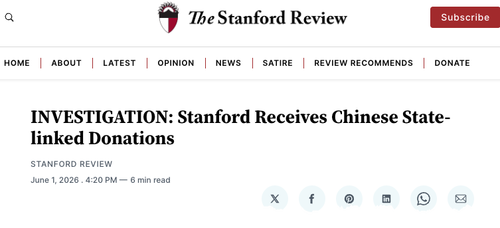
A whistleblower's leak of Stanford University's non-public foreign funding records has exposed millions in donations from Chinese state-linked entities and individuals closely tied to the Chinese Communist Party's united front apparatus. At the center is a $3 million restricted gift in 2025 attributed to 'Chen Yuan' of China, directed specifically to research at the Hoover Institution. Analysis by The Stanford Review identifies this donor as most likely Chen Yuan, former Vice Chairman of the Chinese People's Political Consultative Conference, ex-president of the China Development Bank, and chairman of the China Association for International Friendly Contact (CAIFC) — an organization repeatedly flagged in U.S. government reports as a key vehicle for Beijing's political warfare and overseas influence operations.[1][1]
The connections run deeper than a single transaction. Chen Yuan's sister, Chen Weili, served as a visiting scholar at Stanford. His son, Xiaoxin Chen, is a Stanford alumnus who separately donated over $1 million in 2024. The gift itself was routed unusually through a San Francisco law firm, Adler & Colvin, obscuring the ultimate source in a manner not used by other donors in the disclosures. Hoover itself holds the diaries of Mao Zedong's secretary Li Rui, which include commentary on the Chen family, creating a striking juxtaposition: an institution studying CCP sharp power and hosting sensitive historical materials on senior CCP figures is receiving directed funds from that same elite political lineage.[1]
This revelation fits a larger pattern documented in official U.S. data. Department of Education disclosures under Section 117 of the Higher Education Act show Stanford received over $775 million in reportable foreign gifts and contracts in 2025 alone, with China among the top sources nationwide (over $528 million across U.S. universities). Stanford has reported hundreds of millions from 'countries of concern' in recent years. Other donors in the leaked records include entities like Huawei, BOE Technology (a PLA-linked firm), State Grid, CNPC, and prominent CCP-affiliated figures such as NetEase founder William Ding (a CPPCC member). These funds supported research in AI, semiconductors, energy, and robotics — domains aligned with Beijing's military-civil fusion and 'Made in China 2025' priorities.[2][3]
Mainstream coverage of academic foreign funding often stops at aggregate dollar figures, rarely naming specific united front operatives or tracing multi-generational cultivation like the Chen family's Stanford presence. CAIFC, which Chen chaired, is described in congressional research and U.S.-China Economic and Security Review Commission reports as subordinate to the CCP's Liaison Bureau and central to 'friendly contact' efforts that facilitate influence, elite capture, and technology transfer. The Hoover Institution concurrently runs programs on China's global sharp power and participates in the NSF-funded SECURE initiative (now under House Select Committee on the CCP scrutiny for national security risks), creating potential conflicts where taxpayer-supported research security work coincides with funding from the very actors being analyzed.[4]
Stanford maintains it performs rigorous due diligence, especially on international gifts, and declined further comment citing donor privacy. Yet the use of legal intermediaries and the gap between public Section 117 aggregates and these detailed private records underscore ongoing transparency failures. Prior Stanford Review investigations into CCP espionage on campus — including agents impersonating students and targeting researchers — have already prompted congressional letters and testimony, with the Washington Post describing Stanford as a case study in Beijing's infiltration tactics. This latest leak suggests influence extends beyond espionage to shaping the policy discourse and research agendas at America's most prestigious institutions. The Chen family case illustrates a sophisticated, decades-long strategy of leveraging elite alumni networks, visiting scholars, and targeted donations to prominent think tanks to blunt criticism and gain access. As federal enforcement of foreign funding disclosure strengthens under recent administrations, such exposures may drive reforms: stricter naming requirements, bans on gifts from united front entities, or enhanced vetting for programs handling sensitive geopolitical or technological research.
LIMINAL: This exposure of named high-level CAIFC ties to policy-influencing programs at Hoover will likely intensify congressional pressure for mandatory donor transparency and restrictions on united front-linked gifts, accelerating scrutiny of similar hidden networks across Ivy League and tech-adjacent universities.
Sources (4)
- [1]Investigation: Stanford Receives Chinese State-linked Donations(https://stanfordreview.org/investigation-stanford-receives-chinese-state-linked-donations-2/)
- [2]U.S. Department of Education Releases Latest Foreign Funding Disclosures for Federally Funded American Universities(http://www.ed.gov/about/news/press-release/us-department-of-education-releases-latest-foreign-funding-disclosures-federally-funded-american-universities)
- [3]Stanford is a case study in how Beijing infiltrates U.S. universities(https://www.washingtonpost.com/opinions/2025/06/05/chinese-espionage-stanford-university/)
- [4]Trump admin reveals first-of-its-kind funding data in elite universities(https://www.axios.com/2026/02/11/trump-harvard-stanford-education-department)