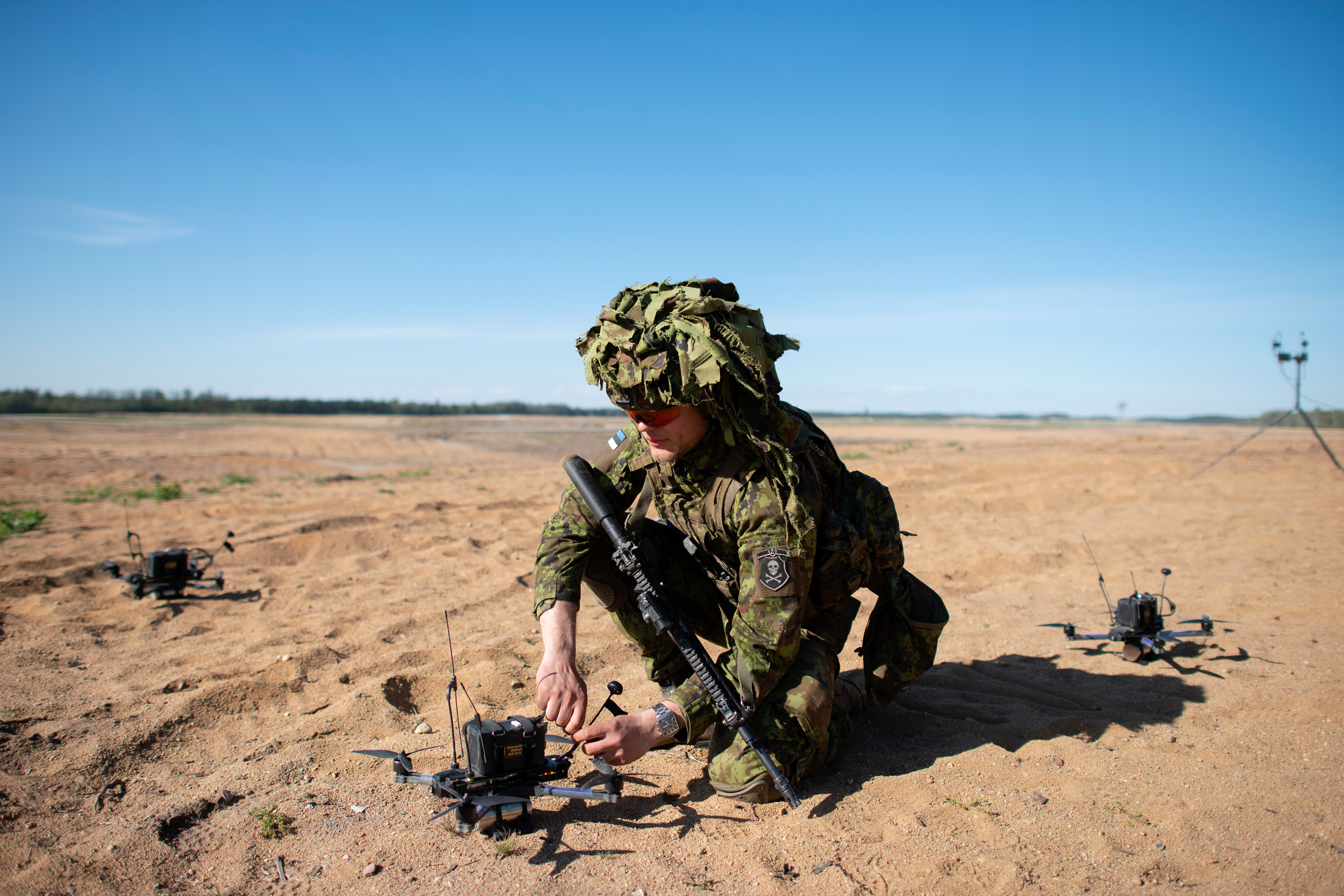
Estonia's Armor-to-Drone Pivot: Ukraine's Attrition Lessons Accelerate NATO's Shift from Heavy Platforms to Asymmetric Systems
Estonia's redirection of €500M from IFV acquisition to drones, counter-drone tech, and air defenses reflects profound Ukraine war lessons on armor vulnerability. This move highlights a NATO-wide doctrinal shift toward attritable unmanned systems, specialized Baltic defense roles, and the limitations of traditional platforms in modern attrition warfare.
Estonia's decision to pause a €500 million infantry fighting vehicle program and redirect those resources into drones, counter-drone systems, electronic warfare, and air defenses is not a simple procurement adjustment but a bellwether for how the grinding realities of the Ukraine war are permanently reshaping European land warfare doctrine. While the Defense News report accurately captures Minister Hanno Pevkur's rationale and the plan to upgrade Estonia's existing fleet of 81 CV90 variants with new electronics, sensors, and targeting systems, it understates the deeper doctrinal rupture underway.
The Ukraine conflict has demonstrated with clinical brutality that traditional armored vehicles operating without integrated layered air defense and electronic warfare are extraordinarily vulnerable. Oryx open-source data combined with RUSI's 2024-2025 battlefield studies show that more than 65% of armored losses on both sides resulted from one-way attack drones, loitering munitions like the Russian Lancet, and FPV systems rather than kinetic anti-tank weapons. Massed mechanized maneuver, the cornerstone of NATO's post-Cold War planning for the Baltic theater, has proven nearly impossible under conditions of persistent aerial surveillance and cheap precision effects. Estonia, with its limited manpower and direct exposure along the Suwalki Gap and Russian border, has drawn the logical conclusion faster than larger allies.
This move stands in deliberate contrast to Latvia's CV90 purchases and Lithuania's ASCOD commitment. Rather than signaling disunity, it reveals an emerging specialization within the Baltic defense cluster: Estonia is positioning itself as the laboratory for small-state asymmetric warfare. Its rapidly growing domestic drone sector, already producing systems exported to Ukraine, benefits directly. The decision to extract another decade of service from second-hand Dutch and Norwegian CV90 hulls while investing in networked unmanned capabilities aligns with the 'system-of-systems' approach advocated in the US DoD's Replicator initiative and the UK’s recent Dragonfire and swarm-drone accelerations.
What mainstream coverage has largely missed is the connection to broader fiscal and industrial patterns across NATO’s eastern flank. A 2025 CSIS report on 'Scaling Unmanned Systems for European Defense' noted that smaller NATO members are reaching the practical limit of traditional platform procurement; unit costs for modern IFVs have ballooned while their survivability window has collapsed. Estonia’s defense spending above 5% of GDP gives it unique flexibility to reallocate without appearing to weaken overall capability—an option unavailable to many larger allies still locked into legacy modernization pipelines. The original article also underplays the interoperability risks: if Baltic neighbors field newer-generation vehicles while Estonia doubles down on upgraded legacy hulls paired with indigenous drones, command-and-control standardization and maintenance chains could fragment.
The Ukraine war’s most enduring lesson is economic as much as tactical: cheap attritable systems can impose disproportionate costs on expensive platforms. Russia’s adaptation of commercial components into mass-produced Lancet and fiber-optic FPV drones has forced Ukrainian forces to disperse armor and prioritize mobile short-range air defense. Tallinn has internalized this faster than most. By extending CV90 service life and pairing the fleet with Estonian-developed unmanned aerial vehicles and counter-UAS suites, the country is building a lighter, more distributed, and ultimately more resilient force posture suited to the dense forests, swamps, and limited maneuver corridors of the Baltic region.
This redirection also accelerates industrial policy shifts. Estonia has spent the last six years nurturing its unmanned systems sector; the new funding will deepen that advantage while pressuring larger European primes to accelerate their own drone roadmaps. However, challenges remain. Upgrading 1980s-era CV90 hulls with modern battle management software capable of seamlessly integrating drone feeds requires significant systems engineering not addressed in public statements. Supply chain vulnerabilities for advanced seekers and air-defense interceptors persist despite Tallinn’s efforts to attract foreign defense investment.
Estonia’s choice illustrates a continent-wide inflection point. From the UK’s reduction in heavy armor ambition to Germany’s quiet expansion of loitering munition programs and the US Army’s own reassessment of brigade combat team structure, the era of assuming armor primacy is ending. The war in Ukraine has proven that in high-intensity peer conflict, the side that can afford to lose hundreds of cheap drones daily while preserving its limited inventory of trained crews and expensive platforms holds the advantage. Estonia, by acting decisively on that lesson, is not merely adapting its own defenses but is charting a path that other resource-constrained NATO allies will increasingly follow.
SENTINEL: Estonia's pivot from new combat vehicles to drones and air defenses is an early indicator that several frontline NATO states will increasingly favor attritable unmanned systems and layered defenses over traditional armor, driven by both the high cost of platforms vulnerable to mass drone attacks and the force-multiplying effects proven in Ukraine.
Sources (3)
- [1]Estonia raids combat-vehicle funds to buy more drones, air defenses(https://www.defensenews.com/global/europe/2026/04/15/estonia-raids-combat-vehicle-funds-to-buy-more-drones-air-defenses/)
- [2]The Attritional Nature of Modern Warfare(https://rusi.org/explore-our-research/publications/commentary/attritional-nature-modern-warfare)
- [3]Scaling Unmanned Systems for European Defense(https://www.csis.org/analysis/scaling-unmanned-systems-european-defense)