Europe's Trade Map Unveils Germany's Enduring Centrality and China's Peripheral Gains Amidst Overlooked Vulnerabilities
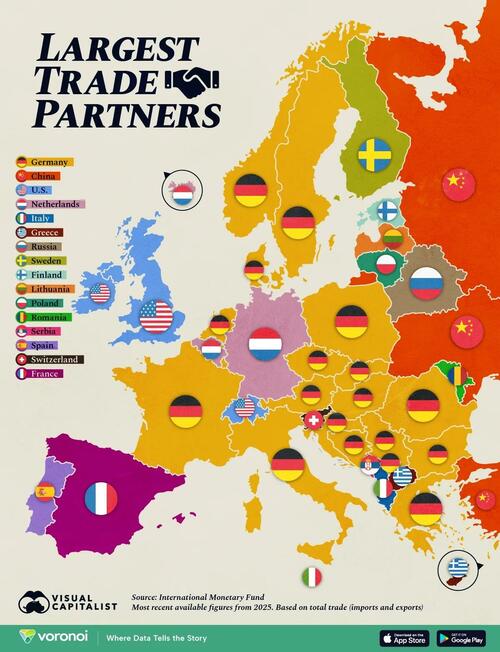
2025 IMF data shows Germany as top trade partner for 19 European countries, the U.S. for three Western outliers, and China displacing traditional ties in Russia, Ukraine, and Turkey. This reveals deep intra-EU dependencies centered on a slowing German economy alongside eastern shifts toward Beijing, signaling ignored vulnerabilities to shocks and foreshadowing multipolar economic realignments across the continent.
Recent IMF data for Q1-Q3 2025 reveals Germany as the dominant trade partner for 19 European countries—over six times more than any other nation—underscoring a deeply integrated but potentially fragile continental economic network. According to Visual Capitalist's mapping of this data, Germany's position at the hub reflects its manufacturing prowess, supply chain centrality, and role in intra-EU commerce, linking it closely to the Netherlands (its own top partner in a $200+ billion relationship), France, Italy, and much of Central Europe. The U.S. emerges as the primary partner for Ireland, the UK, and Switzerland, while regional neighbors dominate elsewhere, such as Spain for Portugal or Poland for Lithuania.[1][2]
Yet the map's most heterodox signal lies in the East: China has become the top trade partner for Russia, Ukraine, and Turkey. This shift, corroborated by trade statistics showing China as Ukraine's leading partner with over $21 billion in flows despite the ongoing conflict, and similar dominance in Russian hydrocarbons-for-manufactures exchanges (totaling $228 billion in 2025), highlights the limits of Western decoupling efforts. For Turkey, China leads in imports by a wide margin, supplying critical machinery and electronics even as overall EU ties remain significant. Eurostat's broader 2025 overview confirms the U.S. as the EU's top export destination and China as the leading import source, but the country-by-country breakdown exposes intra-European asymmetries ignored in standard coverage.[3][4]
Going deeper, these patterns foreshadow larger realignments. Germany's centrality—while a strength—creates systemic vulnerability: its recent industrial slowdowns and energy transition challenges risk cascading across dependent neighbors through intertwined supply chains. Mainstream geopolitical analysis fixates on NATO cohesion or EU strategic autonomy, yet overlooks how this German-led core masks a periphery increasingly oriented toward Beijing. Sanctions intended to isolate Russia have instead accelerated Sino-Russian integration, with China filling gaps left by Western firms and importing Ukrainian grains and Russian energy. Turkey's pivot adds another layer, blending its traditional Western ties with rising Chinese imports amid global supply chain stresses.
This core-periphery dynamic, visible in IMF Direction of Trade Statistics, points to heterodox risks: a potential East-West economic fracture within Europe, heightened exposure to U.S.-China tariff wars or commodity shocks, and the illusion of unified EU policy. Official German trade data echoes these interdependencies, with China also featuring prominently in Berlin's own imports. As multipolar pressures mount, these dependencies—persistent yet underreported—could drive political realignments, from populist pushes against German-led austerity to eastern nations hedging via BRICS-adjacent ties. The data suggests Europe's $30 trillion economy remains far more fragmented and externally influenced than official narratives admit, priming it for disruptive shifts in the coming decade.
Liminal Analyst: Europe's trade dependencies expose a German core vulnerable to stagnation and an eastern periphery tilting toward China, likely accelerating divergent economic loyalties and fragmented responses to global crises beyond NATO-centric views.
Sources (5)
- [1]Mapped: The Top Trade Partner of Every European Country(https://www.visualcapitalist.com/mapped-europes-largest-trade-partners/)
- [2]International trade in goods - Statistics Explained(https://ec.europa.eu/eurostat/statistics-explained/index.php?title=International_trade_in_goods)
- [3]In 2025, China remained Ukraine's top trading partner(https://ubn.news/in-2025-china-remained-ukraines-top-trading-partner/)
- [4]Russia–China trade dips to $228bn in 2025(https://www.intellinews.com/russia-china-trade-dips-to-228bn-in-2025-after-years-of-growth-425961/)
- [5]International Trade in Goods (by partner country) (IMTS)(https://data.imf.org/en/datasets/IMF.STA:IMTS)