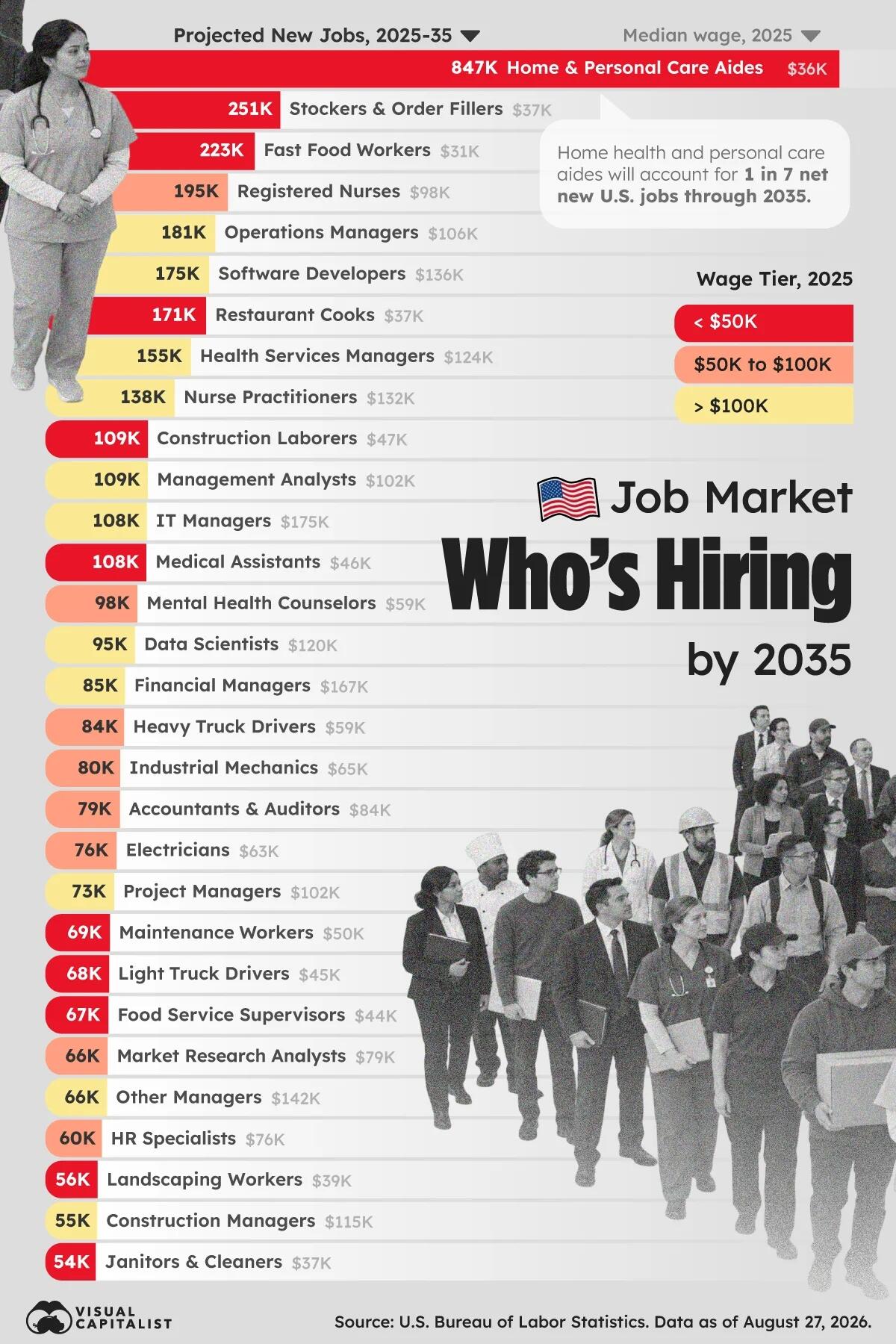
BLS 2025-2035 Projections Show 847,300 New Home Health Aide Jobs as Largest Net Gain
BLS data places eldercare expansion at the center of U.S. job growth through 2035, outpacing tech roles due to demographic realities rather than policy preference. Net gains favor lower-wage home services while higher-skill healthcare tracks offer wage premiums. Labor reallocation will test whether market incentives alone close the gap between displaced coders and projected nurse demand.
The BLS employment outlook released for the 2025-2035 decade records net job growth rather than total openings, isolating expansion from replacement hiring due to retirements. Home health aides top the list while software developers rank sixth with 175,000 additions and registered nurses fourth with 195,000. These figures derive directly from BLS occupational projections that incorporate Census Bureau population forecasts showing adults 65 and older outnumbering children under 18 by 2029.
The documented driver is demographic: an aging population shifting long-term care from institutions to homes, which raises demand for lower-wage direct care roles even as AI reduces certain coding tasks. The two-sided ledger shows the U.S. gains expanded eldercare capacity and fiscal relief from avoided institutional costs, while incurring sustained wage pressure in low-median-pay sectors averaging $35,800 annually. Technology occupations retain higher median wages above $120,000 but deliver smaller net additions.
WEF Future of Jobs data indicates 40 percent of core skills will shift by 2030, favoring analytical thinking alongside domain-specific credentials in nursing. Primary records confirm no federal mandate yet redirects displaced coders; market signals alone are expected to channel labor supply toward nurse practitioner and registered nurse pathways that project 41 percent and 9 percent growth respectively.
Next steps hinge on state licensing reforms and training subsidies that could accelerate nurse supply above current BLS trajectories if enacted before 2028.
BLS: Nurse practitioner employment will surpass 500,000 by 2035 if current 41 percent growth rate holds through the decade.
Sources (2)
- [1]Primary Source(https://www.bls.gov/emp/)
- [2]Supporting Source(https://www.census.gov/library/publications/2023/demo/p25-1145.html)